Table of Contents
If you’ve ever finished a drilling project with numb fingers, aching wrists, or that unsettling tingling sensation creeping up your arm, you’ve already met vibration fatigue face-to-face. It’s the silent productivity killer that turns ambitious DIY projects into endurance tests and eats away at professional contractors’ most valuable asset—their health. While power drills have gotten more powerful and feature-packed over the years, the conversation around what they do to your body has finally moved from the break room to the design lab. In 2026, ergonomic innovation isn’t just a marketing buzzword; it’s a fundamental shift in how manufacturers approach tool design, with vibration reduction sitting at the top of the priority list.
The stakes are higher than most realize. Repeated exposure to drilling vibrations doesn’t just cause temporary discomfort—it can trigger Hand-Arm Vibration Syndrome (HAVS), a permanent and debilitating condition that ends careers and diminishes quality of life. But here’s the good news: modern engineering has cracked the code on vibration dampening, weight distribution, and user-centered design. You don’t have to choose between getting the job done and protecting your body. This guide dives deep into the science, features, and testing protocols that separate genuinely ergonomic drills from pretenders, arming you with the knowledge to make a choice your future self will thank you for.
Top 10 Drills For Vibration Reduction
Detailed Product Reviews
1. DEWALT SDS Rotary Hammer Drill, Vibration Control Shocks, 115 Volts, Corded (D25263K)
 Drill, Vibration Control Shocks, 115 Volts, Corded (D25263K)](https://m.media-amazon.com/images/I/41uY3D12xeL._SL160_.jpg)
Overview: The DEWALT D25263K SDS Rotary Hammer Drill delivers professional-grade performance in a compact package. With 3.0 joules of impact energy and an 8.5 amp motor, this corded tool balances power and control for medium-duty concrete drilling and chipping applications. Part of DEWALT’s Perform and Protect line, it prioritizes user safety without compromising capability.
What Makes It Stand Out: The SHOCKS Active Vibration Control system significantly reduces hand-arm vibration, allowing longer work periods with less fatigue. The rotating brush ring maintains full power in both forward and reverse, a rare feature that adds versatility for backing out jammed bits. The integral clutch protects against sudden torque reactions, enhancing safety on demanding jobsites.
Value for Money: Positioned in the mid-tier professional range, this DEWALT commands a premium over generic brands but justifies it with proven reliability, extensive service networks, and robust warranty support. It’s ideal for contractors who need dependable daily performance without stepping up to costly SDS-Max systems.
Strengths and Weaknesses: Pros include exceptional vibration dampening, durable construction, reverse operation capability, and trusted brand backing. Cons are modest 3.0-joule output limiting heavy demolition, corded design restricting mobility, and higher price than comparable off-brand alternatives. The 1-1/8 inch capacity may prove limiting for some applications.
Bottom Line: Perfect for professionals prioritizing ergonomics and reliability over raw power. The D25263K excels in repetitive medium-duty tasks where reduced vibration translates to productivity gains. While not the most powerful option, its thoughtful features and DEWALT durability make it a smart long-term investment.
2. 1-1/4 Inch SDS-Plus 13 Amp Heavy Duty Rotary Hammer Drill with Safety Clutch 3 Functions, Vibration Control, for Floor Tile Removal, Concrete Breaker, Including Grease, Chisels & Drill Bits

Overview: This heavy-duty SDS-Plus rotary hammer delivers impressive 7.4 joules of impact energy through its 13-amp industrial motor, making it a formidable contender for concrete, masonry, and demolition work. The three-function design covers drilling, hammer drilling, and chipping modes, while the comprehensive accessory bundle provides immediate jobsite readiness.
What Makes It Stand Out: The value proposition is unmatched—this kit includes three drill bits, two chisels, gloves, grease, carbon brushes, and a sturdy carrying case at a price point competitive with bare tools from premium brands. The all-copper motor construction promises enhanced heat resistance for extended duty cycles.
Value for Money: Exceptional. You’re getting professional-level power specifications and a complete starter kit for roughly half the cost of equivalent name-brand tools. For DIY enthusiasts and budget-conscious contractors, this represents significant upfront savings, though long-term durability remains a question mark.
Strengths and Weaknesses: Pros include powerful 13-amp motor, comprehensive accessory package, safety clutch protection, 360-degree handle adjustability, and three operating modes. Cons involve forward-only rotation limiting versatility, unknown brand reliability, potentially shorter lifespan under daily professional use, and vague warranty support. The verbose safety warnings suggest quality control concerns.
Bottom Line: An outstanding entry point for serious DIYers or occasional-use contractors. While it may not match DEWALT’s refinement or longevity, the raw power and included accessories make it a practical choice for those prioritizing budget over brand pedigree. Perfect for tile removal and medium concrete work.
3. 5 Piece 4 Tooth Drill Bit High Strength Eccentric Drill Bit Set for Concrete/Glass/Cast Iron/Tile/Wood. Hexagonal Shank Drills, Short bits, Reduced Vibration, Dry Drills, Sizes: 6+6+8+10+12 mm

Overview: This five-piece drill bit set features an innovative eccentric four-tooth design engineered for multi-material applications. With sizes ranging from 6mm to 12mm, these hex-shank bits tackle concrete, glass, cast iron, tile, and wood using standard drill chucks rather than requiring SDS-plus systems.
What Makes It Stand Out: The unique four-flute geometry accelerates chip removal by 30% compared to conventional bits, reducing heat buildup and extending bit life. The eccentric structure minimizes vibration while maintaining drilling accuracy, and the universal 1/4-inch hex shank ensures compatibility with impact drivers and standard drills.
Value for Money: For users already owning a quality drill or impact driver, this set offers an economical way to handle occasional masonry drilling without investing in a dedicated rotary hammer. The specialized design justifies a slightly higher price than basic masonry bits while delivering superior performance across diverse materials.
Strengths and Weaknesses: Pros include versatile multi-material capability, reduced vibration design, secure hex shank preventing slippage, and fast chip evacuation. Cons involve limited size range, inability to match SDS-plus performance in heavy concrete, potential need for chuck adapters, and unsuitability for demolition work. The bits excel in precision tasks but lack the aggression for deep, large-diameter holes.
Bottom Line: An excellent supplementary set for homeowners and tradespeople needing occasional masonry drilling capability. These bits won’t replace a rotary hammer for professional concrete work but provide remarkable versatility for light to medium tasks across multiple materials. A smart addition to any toolbox.
4. ENEACRO 1-1/4 Inch SDS-Plus 13 Amp Heavy Duty Rotary Hammer Drill, Safety Clutch 4 Functions with Vibration Control Including Grease, Chisels and Drill Bits with Case

Overview: The ENEACRO ENRH3201 rotary hammer positions itself as a feature-rich alternative to premium brands, packing a 13-amp motor that generates 7.4 joules of impact energy. With four operating functions and a comprehensive accessory package, it targets serious DIY users and professionals seeking value without sacrificing capability.
What Makes It Stand Out: The fourth function—chisel angle adjustment—adds valuable versatility for tile removal and precise demolition work. The upgraded double-layer anti-vibration system and PU soft-grip handle demonstrate thoughtful ergonomics, while the included grease, bits, chisels, and gloves provide out-of-box readiness.
Value for Money: Strong. This tool matches the power specs of more expensive competitors while undercutting them on price and including more accessories. The 12.58-pound weight indicates solid construction, though it’s heavier than some professional counterparts. For semi-regular use, it offers compelling economics.
Strengths and Weaknesses: Pros include robust 13-amp power, four-function versatility, safety clutch, effective vibration control, and complete accessory kit. Cons involve brand recognition affecting resale value, SDS-plus limiting maximum hole size to 1-1/4 inches, potentially shorter service life than premium brands, and heavier weight causing fatigue during extended overhead work. The anti-dust bottom structure is a nice durability touch.
Bottom Line: A capable workhorse for demanding DIY projects and light professional applications. While it may not outlast a DEWALT in daily commercial use, the ENEACRO’s power, features, and accessories make it an intelligent purchase for users wanting professional performance at a mid-range price point.
5. DEWALT Rotary Hammer, SDS Max, 2-Inch (D25773K)

Overview: The DEWALT D25773K represents the pinnacle of SDS-Max rotary hammer technology, engineered for heavy-duty drilling and demolition in concrete up to 2 inches in diameter. This professional-grade tool integrates advanced safety systems and intelligent performance monitoring to maximize productivity on the most demanding jobsites.
What Makes It Stand Out: The anti-rotation E-Clutch system sets a new safety standard, automatically detecting bit bind-up and shutting down to prevent sudden torque reactions. Combined with DEWALT’s superior vibration control and constant speed under load technology, this tool maintains performance while protecting the operator in ways generic brands cannot match.
Value for Money: Premium pricing reflects premium engineering. For contractors regularly drilling large-diameter holes or performing extensive demolition, this single tool eliminates the need for separate hammer drill and demolition hammer purchases. The durability and safety features translate to lower long-term operational costs despite higher initial investment.
Strengths and Weaknesses: Pros include revolutionary E-Clutch protection, exceptional vibration reduction, consistent power delivery in high-PSI concrete, variable speed control, and 2-in-1 drilling/demolition capability. Cons involve substantial weight and bulk limiting maneuverability, extremely high purchase price prohibiting casual users, and over-specification for light-duty tasks. This is specialized equipment, not a generalist tool.
Bottom Line: An indispensable tool for concrete professionals and demolition specialists. The D25773K’s intelligent safety systems and relentless performance justify its cost for those who depend on rotary hammers daily. For occasional users, the price is prohibitive, but for pros, it’s a non-negotiable investment in productivity and safety.
6. ENEACRO 1-1/4 Inch SDS-Plus 12.5 Amp Heavy Duty Rotary Hammer Drill, Safety Clutch 3 Functions with Vibration Control Including Grease, Chisels and Drill Bits with Case

Overview: The ENEACRO SDS-Plus Rotary Hammer delivers professional-grade power for demanding concrete and masonry applications. Its 12.5-amp motor generates 7 Joules of impact energy, efficiently drilling up to 1-1/4 inches in concrete while handling light demolition. Weighing 11.1 pounds, it balances substantial power with manageable portability for extended job site use, making it suitable for both serious DIYers and professional contractors.
What Makes It Stand Out: Three-mode functionality (drill-only, hammer-only, rotary hammer) provides exceptional versatility across materials. The dual-switch control system promises twice the lifespan of conventional single-switch designs. A 360-degree adjustable auxiliary handle with PU soft grip, combined with a dual-layer anti-vibration system and automatic safety clutch, demonstrates thoughtful engineering focused on user safety and comfort during prolonged operation.
Value for Money: This model significantly undercuts premium brands like Bosch and Hilti while delivering comparable specifications. The comprehensive kit includes three SDS-Plus drill bits, two chisels, carbon brushes, grease, and a sturdy case—representing substantial savings. Backed by a 24-month warranty, it offers professional features without the professional price tag, paying for itself after a few projects versus rental costs.
Strengths and Weaknesses: Strengths include robust motor performance, comprehensive accessory package, effective vibration dampening, and critical safety features. The sealed anti-dust design ensures longevity in harsh environments. Weaknesses include significant weight causing fatigue during overhead work, and the strong initial odor common to new tools requiring airing out. Some users report the chuck could be more robust for extreme heavy-duty cycles.
Bottom Line: Ideal for serious DIY enthusiasts and professional contractors seeking powerful, versatile concrete drilling and chiseling capability without premium brand pricing. The safety features and comprehensive kit make it a smart investment for regular masonry work.
7. Wuno Shop Anti Vibration Pads, 2"× 2"×7/8" Mechanical Vibration Damping Pads, Heavy Duty Rubber Isolation Pads, 3/8"Pre-Drill Hole Vibration Isolator Pad for Air Compressor

Overview: The Wuno Shop Anti-Vibration Pads provide a simple, effective solution for reducing noise and vibration transfer from heavy machinery. These 2"×2"×7/8" pads feature a rubber-EVA-rubber sandwich construction that isolates equipment like air compressors, HVAC units, and washing machines from floor surfaces, preventing structural vibration and noise pollution in both residential and workshop environments.
What Makes It Stand Out: The three-layer sandwich design outperforms standard solid rubber feet in damping effectiveness. Pre-drilled 3/8-inch holes allow secure mounting, while the compact footprint suits diverse applications from garage compressors to 3D printers. Surprisingly, these pads also excel in audio applications, preventing turntable needle skipping and isolating speakers from vibration, demonstrating remarkable versatility beyond typical mechanical uses.
Value for Money: Delivering professional-grade isolation at a fraction of specialized mounting system costs, these pads offer exceptional ROI. A budget-friendly alternative to costly spring isolators or concrete pads, they provide immediate noise reduction without complex installation. For homeowners battling vibrating appliances, the improvement in comfort and noise levels justifies the minimal investment several times over.
Strengths and Weaknesses: Strengths include superior damping performance, straightforward installation, weather resistance, and broad application range. The pre-drilled holes add mounting security for permanent setups. Weaknesses: strong rubber tire odor requires outdoor off-gassing or repeated washing before indoor use. The 2-inch footprint may be too small for larger equipment feet, and thickness limits load distribution on soft flooring surfaces.
Bottom Line: An affordable, highly effective vibration solution for homeowners and DIYers willing to manage initial odor. Best for compressors, washers, and audio equipment where space allows. Accept the smell as a trade-off for performance that rivals more expensive isolation mounts.
8. 2200W Electric Demolition Jack Hammer, Heavy Duty Concrete Breaker with 4-Piece Set, 65A Impact Force, Vibration Reduction Handle, Carrying Case, Gloves & Earplugs for Construction & Renovation

Overview: This 2200W Electric Demolition Jack Hammer delivers serious breaking power for professional construction and renovation projects. Generating 1,700 BPM with 65A impact force, it efficiently breaks concrete, asphalt, and masonry. The complete kit includes four heat-treated alloy steel chisels, safety gloves, earplugs, and a heavy-duty case, providing a ready-to-use solution for diverse demolition tasks straight from the package.
What Makes It Stand Out: The vibration-reduction system with 360-degree rotating front handle and ergonomic D-grip minimizes operator fatigue during extended use. Safety features include a trigger lock and safety switch preventing accidental activation. Integrated oiling port and cooling vents demonstrate maintenance-forward design for jobsite durability, while the included personal protective equipment shows consideration for user safety.
Value for Money: Competitively priced against rental costs, this jackhammer pays for itself after just a few projects. The inclusion of four professional-grade chisels, safety gear, and a robust storage case represents significant added value. For contractors and serious DIY renovators, it eliminates recurring rental fees while providing on-demand demolition capability and organized transport between job sites.
Strengths and Weaknesses: Strengths include powerful 2200W motor, comprehensive accessory package, effective vibration control, and robust safety features. The molded case keeps everything organized. Weaknesses: at 2200W, it requires adequate power supply and extension cords; substantial weight and noise make it unsuitable for casual users. The tool’s professional capacity may exceed typical homeowner needs, representing overkill for occasional light demolition.
Bottom Line: Excellent investment for contractors and serious renovators tackling major demolition projects. The complete package and safety features justify the purchase for frequent concrete breaking tasks, though it’s likely too much tool for intermittent home use.
9. VEVOR 1-9/16 Inch SDS-Max Rotary Hammer Drill, 13Amp Corded Drills, Heavy Duty Chipping Hammers w/Vibration Control & Safety Clutch, Electric Demolition Hammers Variable Speed, Power Tool For Concrete
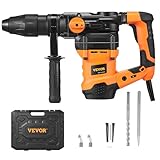
Overview: The VEVOR SDS-Max Rotary Hammer Drill bridges the gap between lighter SDS-Plus tools and massive demolition hammers. Its 13-amp motor delivers 10 Joules of impact energy, drilling up to 1-9/16 inches in concrete with precision. Six-speed variable control (1-6) provides exceptional adaptability for varied materials and applications, making it suitable for heavy-duty concrete work and controlled chipping tasks.
What Makes It Stand Out: The SDS-Max chuck accommodates larger bits for heavier work than SDS-Plus models can handle. Six-speed adjustment allows fine-tuning from delicate tasks to maximum aggression. The 360-degree adjustable handle and vibration control system enhance comfort during extended use, while the heat-resistant copper-wire motor extends duty cycles beyond typical consumer-grade tools, targeting semi-professional users.
Value for Money: Offering SDS-Max capability at SDS-Plus prices, this VEVOR delivers exceptional value for users who’ve outgrown smaller hammers but don’t need $1000+ professional units. The included accessories—drill bit, chisel, grease, carbon brushes—provide immediate functionality. For concrete contractors needing larger capacity for anchor holes and medium demolition, it represents significant savings over premium brands while delivering adequate power.
Strengths and Weaknesses: Strengths include impressive 10J power, variable speed control, SDS-Max versatility, and effective vibration dampening. The adjustable handle improves ergonomics significantly. Weaknesses: only two functions (missing drill-only mode) limits versatility compared to three-mode competitors. The accessory package is sparse compared to some rivals. Build quality, while good, may not match premium brands for daily commercial abuse.
Bottom Line: Perfect for semi-professionals and advanced DIYers needing larger drilling capacity than SDS-Plus offers. The variable speed and SDS-Max compatibility make it a versatile middle-ground option. Accept the limited functions for the price and power, but consider your need for a dedicated drill mode before purchasing.
10. 2200W Electric Demolition Jackhammer,Concrete Breaker Demolition Drills with 4-Piece Set & Vibration Reduction Handle,Jack Hammer Drill with Carrying Case,Gloves & Earplugs for Construction,Renovation

Overview: This 2200W Electric Demolition Jackhammer provides professional-grade concrete breaking power for demanding construction and renovation projects. Delivering 1,700 BPM, it efficiently tackles concrete, asphalt, and masonry removal. The complete ready-to-use kit includes four alloy steel chisels, protective gloves, noise-reducing earplugs, and a rugged carrying case with shoulder strap, supporting safe and efficient work immediately.
What Makes It Stand Out: The advanced vibration-absorbing shock system with 360-degree rotating front handle and ergonomic D-grip provides superior control and comfort. Built-in safety switch and trigger lock prevent accidental activation during transport or setup. The professional maintenance system with easy-access oiling port and efficient cooling vents ensures optimal motor performance and extended lifespan during intensive demolition sessions.
Value for Money: This comprehensive kit eliminates rental costs after just a few uses, making it economical for contractors and serious DIYers undertaking multiple renovation projects. The inclusion of personal protective equipment and a well-organized case with shoulder strap adds professional value. For renovation work requiring regular demolition, it offers better ROI than repeated rentals while ensuring you have the right tool when needed.
Strengths and Weaknesses: Strengths include powerful motor, effective vibration reduction, complete accessory package, and robust safety features. The shoulder strap enhances case portability between job sites. Weaknesses: heavyweight design requires physical stamina and proper lifting technique; 2200W power draw demands appropriate electrical supply. Noise levels mandate hearing protection (fortunately included). The professional-grade capacity may prove excessive for occasional home improvement tasks.
Bottom Line: A solid choice for professionals and dedicated renovators needing reliable demolition power. The complete package and thoughtful design features justify the investment for frequent concrete breaking and removal tasks, though intermittent users should consider lighter alternatives or rentals.
Understanding Vibration Fatigue: The Hidden Cost of Power Drilling
What Is Vibration Fatigue and Why Does It Matter?
Vibration fatigue isn’t just sore muscles—it’s a complex physiological response to repeated mechanical oscillations traveling through your hands and arms. When you grip a drill, vibrations between 5 Hz and 1,500 Hz transmit directly into soft tissues, blood vessels, and nerves. Over time, this mechanical insult causes microtrauma to capillaries, desensitizes nerve endings, and triggers inflammatory responses that your body can’t keep up with. The result? Reduced grip strength, loss of fine motor control, chronic pain, and in severe cases, permanent nerve damage. What makes it particularly insidious is its cumulative nature; you might not feel the damage until years of exposure have already taken their toll.
The Science Behind Power Tool Vibrations
Drills generate vibration through multiple sources: the motor’s electromagnetic pulses, gear meshing imperfections, chuck imbalance, and the actual cutting action at the bit. Each source creates a unique frequency signature, and your hands absorb all of it. High-frequency vibrations (above 100 Hz) tend to affect nerves first, causing tingling and numbness. Lower frequencies (5-50 Hz) impact muscles and joints, leading to deep tissue fatigue and joint strain. The most damaging drills produce what’s called “broadband vibration”—a chaotic mix of frequencies that overwhelms your body’s natural damping mechanisms. Understanding this spectrum is crucial because effective ergonomic design targets specific frequency ranges with tailored solutions.
Why Ergonomic Design Matters More Than Ever in 2026
The Evolution of Drill Ergonomics
The ergonomic revolution in power tools didn’t happen overnight. Early cordless drills were essentially motor-blocks with handles bolted on—functional but brutal on the body. By 2026, manufacturers have moved beyond simple rubber grips. We’re seeing computer-modeled anthropometric data shaping every contour, finite element analysis optimizing weight distribution, and active vibration cancellation borrowed from aerospace engineering. The shift is driven by both regulation and market demand; European Union directives on workplace vibration exposure have pushed global innovation, while aging DIYers and health-conscious pros have created a market that rewards genuine ergonomic investment.
Long-Term Health Implications
Ignore vibration fatigue and you’re not just risking tomorrow’s comfort—you’re gambling with your long-term health. Hand-Arm Vibration Syndrome progresses through stages, beginning with intermittent tingling and advancing to permanent loss of sensation, Raynaud’s phenomenon (white finger disease), and even bone cysts in the wrists. For professionals, this isn’t hypothetical; it’s an occupational hazard that has led to class-action lawsuits and workers’ compensation claims across the construction industry. The cost of a premium ergonomic drill pales in comparison to lost income, medical bills, and diminished quality of life.
Key Ergonomic Features That Actually Reduce Vibration
Anti-Vibration Handles and Grips
The first line of defense is where your hand meets the tool. Modern anti-vibration handles use multi-density elastomers that absorb specific frequencies while maintaining torsional rigidity. Look for grips with isolation zones—strategic gaps or flexible membranes that create a mechanical decoupling between the motor housing and your hand. Some designs incorporate gel-filled chambers that dissipate vibration energy as heat, while others use geometric patterns inspired by nature to disrupt vibration transmission paths. The key is that these aren’t just thicker rubber; they’re engineered damping systems.
Dynamic Vibration Absorption Systems
Passive damping is old news. The cutting edge in 2026 involves active systems that counteract vibrations in real-time. These mechanisms use tuned mass dampers—small internal weights that oscillate out-of-phase with the drill’s vibrations, effectively canceling them out. More advanced systems employ piezoelectric sensors that detect vibration signatures and trigger counter-movements faster than you can perceive. This technology, adapted from high-end camera stabilization, can reduce handle vibration by up to 70% in real-world conditions.
Weight Distribution and Balance Engineering
A drill’s center of gravity should sit directly over your grip, not forward in the chuck or back in the battery. Engineers achieve this through clever component placement: positioning the motor at a slight angle, using asymmetrical battery housings, and incorporating counterweights in the tail. The goal is neutral balance—you should be able to balance the drill horizontally on a single finger placed at the grip’s center. This balance reduces the static load on your wrist, which amplifies the effects of dynamic vibration.
The Role of Brushless Motors in Vibration Reduction
How Motor Design Impacts User Comfort
Brushless motors aren’t just about efficiency and power—they’re inherently smoother. Traditional brushed motors create vibration through physical contact between brushes and commutator, generating high-frequency chatter that drills straight into your palm. Brushless designs eliminate this mechanical interface, producing a cleaner rotational force. The electronic commutation in modern brushless motors also allows for micro-adjustments to torque delivery, smoothing out the power pulses that cause low-frequency judder. In 2026, we’re seeing second-generation brushless motors with optimized magnet spacing and advanced controllers that further refine this smoothness.
Battery Technology and Its Surprising Impact on Ergonomics
Weight vs. Power: Finding the Sweet Spot
The battery is the heaviest single component in any cordless drill, and its placement determines the tool’s rotational inertia. New lithium-silicon and solid-state batteries in 2026 offer higher energy density, meaning more power from less weight. But the real ergonomic win comes from modular battery systems that let you choose capacity based on task. A compact 2Ah battery for overhead work might give you 40% less runtime but reduces wrist strain by over 30% compared to a bulky 6Ah pack. Smart chargers also play a role, with adaptive charging profiles that maintain battery health, ensuring consistent performance and preventing the voltage sag that can cause a drill to labour and vibrate more.
Grip Design: The First Line of Defense
Contoured vs. Traditional Handles
Your hand isn’t a cylinder, so why grip one? Contoured handles map to the natural curves of your palm and fingers, distributing pressure evenly and reducing hotspots that amplify vibration perception. The best designs offer multiple grip zones—a power grip area for high-torque applications and a precision grip zone for delicate work. Some even feature adjustable palm rests that slide forward or back to accommodate different hand sizes. This isn’t about comfort; it’s about biomechanical efficiency. A properly contoured grip can reduce muscle activation by up to 25%, delaying fatigue significantly.
Material Science in Grip Construction
The rubber overmold on a premium drill in 2026 is a composite sandwich. The inner layer is a firm thermoplastic elastomer that provides structural support and vibration isolation. The outer layer uses softer, textured compounds with micro-channels that wick away sweat and provide tactile feedback without slip. Some manufacturers are experimenting with phase-change materials that soften under pressure, creating a custom fit to your hand over time. The durometer (hardness) of these materials is precisely tuned—too soft and you lose control; too firm and you transmit vibration.
Trigger Sensitivity and Variable Speed Control
A jerky trigger is an ergonomic failure. Modern drills feature Hall-effect sensors that provide infinitely variable speed control with no physical contacts to wear out. The trigger’s travel distance and resistance are calibrated to give you precise control from 0 to maximum RPM, preventing the lurching starts that cause wrist snap. Look for models with programmable speed curves—you can set a soft-start mode for delicate materials or a aggressive ramp-up for production work. This control means you’re not fighting the tool; you’re conducting it.
The Importance of Proper Drill Weight and Balance
Understanding Center of Gravity
Weight itself isn’t the enemy—poorly distributed weight is. A 5-pound drill that balances perfectly can feel lighter than a 4-pound drill with a forward bias. The center of gravity should align with the metacarpal bones in your hand, creating a direct force path to your forearm. When a drill is nose-heavy, your wrist extensors must constantly fire to keep the bit aligned, accelerating fatigue. Test this by holding the drill in a loose grip and seeing if it wants to tip forward. If it does, that tool will fight you all day.
Vibration Dampening Technologies Explained
Mechanical Isolation Systems
Think of these as shock absorbers for your drill. Elastomeric isolation mounts separate the motor and gearbox from the main housing, creating a floating drive system. The mounts are tuned to the drill’s primary vibration frequency, absorbing energy before it reaches your hand. Some designs use coil springs or even magnetic levitation in the chuck assembly to decouple the cutting forces from the body. The sophistication of these systems is a key differentiator—cheap drills use a single rubber bushing; premium tools use multi-stage isolation.
Electronic Counterbalance Mechanisms
This is where 2026 technology gets exciting. Accelerometers in the handle detect vibration patterns in real-time, feeding data to a microcontroller that adjusts motor timing and torque output to counteract them. It’s like noise-canceling headphones for your hands. These systems can adapt to different bits and materials, learning the vibration signature of a spade bit in wood versus a masonry bit in concrete and optimizing damping accordingly. The result is a consistently smooth experience across applications.
Noise Reduction as an Ergonomic Factor
Vibration and noise are two sides of the same coin. The same mechanical impacts that rattle your bones also assault your ears, and the stress response to loud noise amplifies your perception of vibration. Modern ergonomic drills address this with precision-machined gear trains that reduce backlash, sound-dampening foam in the housing, and aerodynamic fan designs that minimize air turbulence. A quieter drill is inherently less fatiguing because it reduces your overall sensory load. Look for models that publish dBA ratings and aim for anything under 75 dBA under load.
Smart Features That Enhance Ergonomic Benefits
Bluetooth Connectivity and App Integration
Your drill shouldn’t be a dumb tool. Bluetooth-enabled models in 2026 connect to smartphone apps that track vibration exposure over time, alerting you when you’re approaching daily limits set by health authorities. These apps can also log which tasks generate the most vibration, helping you optimize technique or switch tools before fatigue sets in. Some systems even adjust the drill’s performance parameters based on your personal vibration tolerance profile, prioritizing your health over raw speed.
Adaptive Power Management
Smart drills monitor motor temperature, battery voltage, and load conditions to prevent the bogging-down that causes violent vibration spikes. When the bit starts to bind, the system momentarily reduces torque instead of letting the drill kick back. This not only protects your wrist but also extends bit life and improves hole quality. The electronics act as a co-pilot, smoothing out the power delivery so your hands don’t have to absorb the shocks.
Professional vs. DIY: Ergonomic Needs Differ
What Contractors Should Prioritize
If you’re drilling 200 holes a day, your needs are extreme. Prioritize tools with the highest vibration reduction ratings (look for ISO 28927-2 compliance data). Replaceable grip inserts are crucial because you’ll wear through them. Quick-shift balance adjustments that let you reconfigure the drill for different orientations (overhead, horizontal, downward) can save your shoulders as well as your hands. Don’t skimp on warranty—professional use will test every ergonomic claim.
Weekend Warrior Considerations
For occasional use, versatility beats specialization. A mid-weight drill with good all-around ergonomics will serve you better than a heavy professional model. Focus on intuitive controls and comfortable grip over advanced damping systems you won’t use enough to justify the cost. However, don’t ignore vibration entirely—even occasional exposure adds up over years of home projects. A brushless motor and basic isolation mounts are worth the small premium.
How to Test Ergonomic Claims Before Buying
In-Store Testing Protocols
Don’t just hold the drill—use it. Bring a scrap piece of wood and actually drill holes. Pay attention to the 30-second mark, not just the first impression. Does vibration increase as the motor warms up? Can you maintain a light grip without the drill twisting? Try overhead and horizontal positions. A truly ergonomic drill should feel stable with minimal muscular effort. Ask to test it with different batteries and bits; some drills feel great with a small battery but become unwieldy with a high-capacity pack.
Reading Between the Lines of Spec Sheets
Manufacturers love to quote “tri-axial vibration values” measured in m/s², but these lab numbers rarely match real-world use. Look for the “uncertainty of measurement” figure—if it’s not listed, the number is meaningless. Check whether the rating is for continuous operation or intermittent use. The K-factor, which indicates how vibration varies with different bits, is more important than the headline number. Also, examine the service interval for vibration-damping components; if they need replacement every 50 hours, that’s a hidden cost.
Maintenance Tips to Preserve Ergonomic Benefits
Your drill’s ergonomic features are only effective if they’re maintained. Replace isolation mounts and grip inserts according to the manufacturer’s schedule—worn dampers can actually amplify vibration. Keep the chuck clean and properly lubricated; a sticky chuck transmits more shock. Store batteries at room temperature; cold batteries perform poorly and cause the motor to labour. Periodically check for loose screws in the housing, which can compromise the integrity of vibration isolation systems. A well-maintained ergonomic drill will protect you for years; a neglected one becomes a health hazard.
Frequently Asked Questions
How many hours of drilling before vibration becomes dangerous?
Health authorities like the UK’s HSE recommend keeping exposure below 2.5 m/s² A(8) over an 8-hour day, which translates to roughly 2-3 hours of continuous drilling with a typical mid-range tool. However, individual susceptibility varies dramatically. Factors like grip strength, pre-existing conditions, and even ambient temperature affect your risk. The key is to monitor symptoms: if you feel tingling that persists more than 30 minutes after stopping, you’re already overexposed.
Can ergonomic drills completely eliminate vibration?
No tool can eliminate vibration entirely—that’s physically impossible when you’re cutting material. The goal is reduction, not elimination. Premium ergonomic drills can cut vibration by 50-70% compared to basic models, but you’ll still feel some feedback. This is actually beneficial; complete isolation would reduce your control and increase the risk of binding or wandering bits. The sweet spot is damping the harmful frequencies while preserving useful tactile feedback.
Are corded drills inherently less ergonomic than cordless?
Not necessarily. Corded drills eliminate battery weight, which can improve balance, but they often run at higher RPMs with less sophisticated speed control, potentially increasing high-frequency vibration. Modern cordless drills with brushless motors and advanced electronics often have the edge in active damping. The real difference is in the quality tier—a premium corded drill will outperform a cheap cordless model, and vice versa.
Do vibration ratings change as the drill ages?
Absolutely. Isolation mounts compress and lose elasticity, bearings develop play, and gear teeth wear, all of which increase vibration transmission. A drill that tested at 4.5 m/s² new might be delivering 6 m/s² after a year of heavy use. This is why professional tools have service intervals specifically for ergonomic components. For DIY users, plan on replacing dampers every 3-5 years even if the drill still “works fine.”
Is a heavier drill better for vibration damping?
Weight helps with low-frequency stability but can worsen high-frequency transmission. A heavier drill has more inertia, so it resists the slow juddering that comes with large bits. However, that same mass provides a more efficient path for high-frequency vibrations to travel into your hand. The ideal is moderate weight with excellent isolation—around 4-5 pounds for an 18V drill—paired with active damping systems that target the frequencies your body is most sensitive to.
Can gloves improve vibration protection?
Standard work gloves offer minimal protection and can actually increase grip force, worsening fatigue. Anti-vibration gloves with specialized padding can help, but they’re a supplement, not a solution. They work best for intermittent exposure above safe limits, not as a daily substitute for a proper ergonomic drill. Be wary of gloves that are too thick; they reduce dexterity and can lead to unsafe handling. Always prioritize tool design over personal protective equipment.
How do I know if a drill’s ergonomic features are working for me?
Trust your body, not just the specs. After a 15-minute drilling session, you should be able to make a tight fist without pain or tingling. Your grip strength should feel unchanged. If you notice delayed onset muscle soreness in your forearms the next day, the drill is forcing you to over-grip. Keep a simple log of your symptoms for the first few weeks with a new drill; subjective comfort correlates strongly with objective risk reduction.
Are brushless motors always smoother than brushed?
In theory, yes. In practice, the quality of the electronic speed controller matters enormously. A cheap brushless motor with crude timing can be just as jerky as a brushed motor. Look for drills that advertise “sensorless field-oriented control” or “FOC”—this advanced algorithm smooths torque delivery dramatically. Also, check for user reviews that specifically mention smooth startup and consistent power; these are telltale signs of good motor control.
What maintenance preserves a drill’s anti-vibration features?
Replace isolation mounts and grip inserts on schedule, keep the chuck clean, and avoid dropping the drill—even minor impacts can misalign internal dampers. Store it in a case to protect the precision balance. For contractors, send tools in for annual service that includes vibration testing. DIY users should do a “feel test” every six months: if it suddenly feels more buzzy, something has failed internally.
Will ergonomic drills cost more in 2026?
Premium ergonomic features add 20-40% to the price compared to baseline models, but the gap is narrowing as technology becomes standard. Brushless motors and basic isolation are now common even in mid-range tools. Consider it an investment in your health: spending an extra $50-$100 now can prevent thousands in medical costs later. For professionals, the ROI is immediate in reduced fatigue and increased daily productivity.
See Also
- Stop Vibration Fatigue with the 10 Best Ergonomic Cordless Drills This Year
- How to Solve Vibration Fatigue with the 10 Best Compact Cordless Drills in
- Stop Vibration Fatigue with the 10 Best Cordless Drills This Year
- Stop Hand Fatigue with the 10 Best Manual Drills This Year
- 10 Brushless Motor Cordless Drills That Outlast Brushed Models in 2026—Lab-Tested
