Table of Contents
Investing in the right table saw is the single most consequential decision you’ll make when equipping a woodworking shop. This one tool becomes the heartbeat of your operation—ripping sheets of plywood to dimension, cutting tenons for furniture joinery, and executing countless tasks that define the quality of your finished pieces. Yet with so many configurations, power ratings, and safety technologies available, even seasoned woodworkers can feel overwhelmed by the options. Whether you’re upgrading from a contractor model to a precision cabinet saw or setting up your first dedicated shop space, understanding the nuanced differences between categories and features will save you thousands of dollars and years of frustration.
This comprehensive guide cuts through marketing jargon to deliver actionable insights from professional woodworkers and shop managers. We’ll explore the four primary saw categories, dissect the engineering details that separate adequate tools from exceptional ones, and examine the safety systems that protect your most valuable asset—your hands. By the end, you’ll possess the framework to evaluate any table saw based on your specific workflow, shop constraints, and long-term growth plans, not just manufacturer specifications.
Top 10 Table Saws For Woodworking Shops
Detailed Product Reviews
1. Shop Fox W1837 10" 2 hp Open-Stand Hybrid Table Saw

###1. Shop Fox W1837 10" 2 hp Open-Stand Hybrid Table Saw
Overview: The Shop Fox W1837 bridges the gap between contractor and cabinet saws, offering serious hobbyists a taste of professional features. This hybrid machine packs a 2 HP motor that runs on either 120V or 240V (prewired for 120V), delivering robust cutting power. Its precision-ground cast-iron table with steel wings spans 40-1/4 inches, providing ample support for large workpieces, while the 30-inch rip capacity handles substantial stock.
What Makes It Stand Out: Unlike pure contractor saws, the W1837 features an enclosed cabinet bottom with a 4-inch dust port, significantly improving dust collection and cleanliness in your workshop. The dual-voltage capability allows you to upgrade your electrical setup later without replacing the saw. The hybrid design retains the power and stability of cabinet saws while staying somewhat lighter than full cabinet models.
Value for Money: Positioned in the mid-range price bracket, this saw delivers exceptional value for woodworkers ready to move beyond entry-level equipment. It competes with saws costing hundreds more, offering cast-iron construction and cabinet-style dust management that contractor saws lack. For serious hobbyists, it’s an investment that eliminates the need for an immediate upgrade.
Strengths and Weaknesses: Strengths include powerful dual-voltage motor, superior dust collection, large cast-iron table, and stable cutting performance. Weaknesses involve its considerable weight limiting mobility, open-stand design being less rigid than full cabinets, and requiring significant assembly time. The 30-inch rip capacity, while adequate, trails some competitors.
Bottom Line: The W1837 is ideal for dedicated woodworkers seeking cabinet saw features without the premium price. It offers substantial long-term value for stationary workshop setups where power and precision outweigh portability needs.
2. DEWALT Table Saw 10 Inch with Foldable Rolling Table Saw Stand, 15 Amp, 4800 RPM, 32-1/2-Inch Rip Capacity (DWE7491RS)
 with Foldable Rolling Table Saw Stand, 15 Amp, 4800 RPM, 32-1/2-Inch Rip Capacity (DWE7491RS)](https://m.media-amazon.com/images/I/41aHc-jYnVL._SL160_.jpg)
Overview: DEWALT’s DWE7491RS represents the gold standard for portable table saws, engineered for professional contractors who refuse to compromise on performance. This 15-amp powerhouse spins at 4,800 RPM, delivering clean cuts through hardwoods and sheet goods alike. The integrated rolling stand transforms from transport to cutting mode in seconds, while the massive 32-1/2-inch rip capacity rivals many stationary saws.
What Makes It Stand Out: The rack-and-pinion telescoping fence system sets this saw apart, delivering smooth, accurate adjustments that stay parallel to the blade without constant recalibration. Patented material support wings extend for narrow rip cuts, enhancing safety and control. The onboard storage system keeps all accessories—including the blade guard, fence, riving knife, and push stick—organized and accessible.
Value for Money: While commanding a premium price, this saw delivers professional-grade features that justify every dollar. It eliminates the need for a separate miter saw for many cuts and its durability ensures years of reliable service. For contractors, the time saved in setup and breakdown alone offsets the higher initial cost.
Strengths and Weaknesses: Strengths include exceptional fence accuracy, best-in-class rip capacity, robust rolling stand, and comprehensive onboard storage. The powerful motor handles demanding cuts effortlessly. Weaknesses include a higher price point than competitors, an aluminum table that can dent, and weight that challenges true one-person portability. It’s less suited for fine furniture work requiring极致precision.
Bottom Line: For mobile professionals and serious DIYers prioritizing performance and portability, the DWE7491RS is unmatched. It’s a reliable workhorse that earns its keep on any job site.
3. SKIL 15 Amp 10 Inch Portable Jobsite Table Saw with Folding Stand- TS6307-00
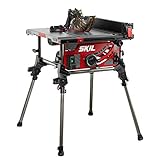
Overview: SKIL’s TS6307-00 brings professional features to budget-conscious buyers, offering a compelling package for DIY enthusiasts and occasional users. This 15-amp jobsite saw delivers sufficient power for most home projects, cutting material up to 4x4 at 90 degrees. The integrated folding stand provides convenient storage and transport, while the rack-and-pinion fence rails ensure consistent alignment.
What Makes It Stand Out: The parallel blade alignment system with micro-adjustment is remarkable at this price point, typically found on premium saws. This feature ensures the blade remains perfectly parallel to the fence and miter slot, dramatically improving cut quality. The 2-47° bevel capacity with positive stops at 0° and 45° offers versatility for various joinery tasks.
Value for Money: This saw represents exceptional value, delivering features like rack-and-pinion adjustment and 4x4 cutting capacity at a fraction of professional saw prices. It’s an ideal entry point for homeowners tackling renovation projects without investing in contractor-grade equipment. The three-year warranty adds peace of mind.
Strengths and Weaknesses: Strengths include an affordable price, surprisingly accurate fence system, excellent portability, and versatile bevel range. The 4x4 cutting capacity handles dimensional lumber efficiently. Weaknesses include less robust build quality than premium brands, a smaller table surface limiting support for large sheets, and motor strain on continuous heavy cuts. The stand, while functional, lacks the stability of higher-end models.
Bottom Line: The TS6307-00 is the smart choice for budget-minded woodworkers needing reliable performance for occasional use. It delivers pro-inspired features without the premium cost, making it perfect for home improvement projects.
4. The Hedgehog Featherboard for Table Saws for Quicker, Easier, and Safer Workflow | Improve your accuracy and precision

Overview: The Hedgehog Featherboard revolutionizes a traditional safety device with its innovative spiral design and single-knob adjustment system. Engineered to fit standard 3/4-inch miter slots found on most table saws (excluding 5/8-inch slots), this American-made accessory streamlines workflow while enhancing safety. Its compact design delivers consistent pressure against the fence, keeping workpieces stable during rip cuts.
What Makes It Stand Out: The one-handed, tool-free adjustment is a game-changer. Unlike traditional featherboards requiring dual knobs and careful positioning, the Hedgehog’s single pivot point allows instant repositioning. This saves valuable time during repetitive cuts and reduces setup frustration. The unique spiral design applies even pressure while allowing smooth stock feed, minimizing binding and kickback risk.
Value for Money: Priced competitively with premium traditional featherboards, the Hedgehog offers superior convenience that justifies its cost through time savings alone. For production woodworkers or anyone performing repetitive operations, the efficiency gains quickly offset the modest investment. It’s a small upgrade delivering disproportionate workflow improvements.
Strengths and Weaknesses: Strengths include lightning-fast adjustments, robust construction, excellent workpiece control, and enhanced safety through reduced kickback. The single-knob design is intuitive and ergonomic. Weaknesses include incompatibility with 5/8-inch miter slots (though a separate adapter exists), limited to 3/4-inch width, and a higher price than basic featherboards. Some users may prefer dual-featherboard setups for very narrow stock.
Bottom Line: The Hedgehog Featherboard is a must-have upgrade for any table saw user prioritizing efficiency and safety. Its clever design transforms a tedious adjustment process into a seamless experience, making it invaluable for both hobbyists and professionals.
5. Peachtree Woodworking Supply Safety, Push Block and Push Stick Package, In Safety Orange Color, Router Tables, Jointers and Band Saws and other Work Shop Machinery (5 Piece Set)

Overview: Peachtree Woodworking’s five-piece safety kit provides comprehensive hand protection for multiple workshop machines. The vibrant safety orange color ensures high visibility, helping users track hand positions during cutting operations. This versatile set includes two small push blocks (angled and offset handles), one large push block, and two push sticks (standard and V-style narrow design), covering everything from table saws to jointers and router tables.
What Makes It Stand Out: The kit’s completeness stands out—five distinct tools for different applications eliminates guesswork about proper safety devices. The soft, receptive rubber foam pads on the push blocks provide superior grip and control compared to bare wood or plastic alternatives. The high-visibility color scheme is more than aesthetic; it’s a practical safety feature preventing tools from blending into workshop clutter.
Value for Money: This affordable set delivers exceptional value, costing less than purchasing individual safety devices separately. For beginners setting up their first workshop, it provides instant, comprehensive protection across multiple tools. The washable rubber soles extend lifespan, though requiring 24-hour drying time.
Strengths and Weaknesses: Strengths include versatility across multiple machines, excellent grip from rubber pads, high visibility, and inclusive sizing options. The variety ensures proper technique for different cuts. Weaknesses include foam pads that may wear over time, push sticks that could be longer for larger tables, and basic construction prioritizing function over durability. The V-stick’s narrow design may feel flimsy on heavy stock.
Bottom Line: This kit is an essential starting point for any woodworker, particularly beginners. While not premium-grade, it provides reliable, versatile safety protection at an unbeatable price, making smart safety accessible to everyone.
6. Pony Portable Folding Work Table, 2-in-1 as Sawhorse & Workbench, 31” W×25” D×25”-35”H, Large Load Capacity with 4pcs Clamps, 4pcs Bench Dogs

Overview: The Pony Portable Folding Work Table delivers exceptional versatility for DIY enthusiasts and professionals who need adaptable workspace solutions. This 2-in-1 design seamlessly transforms between a sturdy workbench and a robust sawhorse, accommodating various project requirements. With dimensions of 31" W × 25" D and height adjustable from 30" to 35", it offers six configurable positions for ergonomic working conditions in garages, gardens, or jobsites.
What Makes It Stand Out: The dual-functionality sets this apart from single-purpose work supports. The aluminum leg frame provides superior strength, supporting 500 lbs as a workbench and an impressive 1000 lbs as a sawhorse. The comprehensive accessory package includes two 12" medium-duty bar clamps, two 6" light-duty clamps, two large and two small bench dogs, plus safety straps—everything needed for immediate project starts without additional purchases.
Value for Money: Purchasing separate sawhorses, a workbench, and quality clamps would easily exceed $200. This integrated solution offers substantial savings while eliminating storage headaches. The included accessories alone represent significant value, making it an economical choice for budget-conscious woodworkers and contractors.
Strengths and Weaknesses: Pros include remarkable versatility, substantial weight capacity, excellent portability, and the inclusive accessory bundle. The six-height adjustment accommodates various users and tasks. Cons involve potential stability concerns when fully extended, plastic components that may wear over heavy use, and initial assembly time. The 31" width might feel restrictive for larger panel work.
Bottom Line: This Pony work table excels for users needing flexible, portable workspace. It’s ideal for DIYers, hobbyists, and professionals who prioritize adaptability and value. While not replacing a permanent workbench, it’s an indispensable secondary surface for jobsites and small workshops.
7. Jigs & Fixtures for the Table Saw & Router: Get the Most from Your Tools with Shop Projects from Woodworking’s Top Experts (Fox Chapel Publishing) 26 Innovative Designs (Best of Woodworker’s Journal)

Overview: This compilation from Woodworker’s Journal offers 26 expert-designed jigs and fixtures to maximize table saw and router capabilities. Published by Fox Chapel Publishing, the book serves as a comprehensive resource for woodworkers seeking to enhance accuracy, safety, and efficiency. It transforms basic tools into precision instruments through clever shop-built accessories that solve common woodworking challenges.
What Makes It Stand Out: The projects come from “Woodworking’s Top Experts,” ensuring proven, reliable designs rather than experimental concepts. The dual-tool focus covers both table saw and router applications, providing exceptional versatility. Each jig addresses specific workshop needs, from crosscutting sleds to router tables, offering immediate solutions for common frustrations.
Value for Money: Individual jig plans typically cost $5-$15 each, making this collection worth potentially $130+ in separate purchases. The book format provides organized, accessible instruction with professional insights that prevent costly mistakes. For woodworkers who value time and precision, this represents significant savings over trial-and-error development.
Strengths and Weaknesses: Pros include expert-curated designs, cost-effective plan collection, and comprehensive coverage of essential jigs. The variety suits multiple skill levels and project types. Cons include lack of listed features making specific material details unclear, potential datedness in some designs, and requirement for intermediate skills to execute complex jigs properly. Beginners may find some projects intimidating without step-by-step photos.
Bottom Line: Essential for intermediate to advanced woodworkers wanting to expand their shop capabilities economically. While not a beginner’s manual, it’s an invaluable reference that pays for itself with the first completed project. Perfect for those ready to elevate their precision and safety.
8. DEWALT 15 Amp 8-1/4 in. Compact Portable Jobsite Table Saw (DWE7485)

Overview: The DEWALT DWE7485 combines professional-grade performance with exceptional portability, making it a jobsite favorite. Its 15-amp motor powers an 8-1/4-inch blade through demanding cuts, while the compact design ensures easy transport. With 24.5 inches of rip capacity, it handles full-size sheet goods, delivering capabilities typically found in larger, stationary saws.
What Makes It Stand Out: The rack-and-pinion telescoping fence system provides micro-adjustable accuracy that rivals cabinet saws, ensuring perfectly square cuts every time. The metal roll cage base withstands brutal jobsite conditions where plastic bases crack. On-board storage for guard, fence, wrenches, and miter gauge eliminates lost accessories—a common frustration with portable saws.
Value for Money: While priced at a premium compared to entry-level jobsite saws, the DWE7485 justifies its cost through superior fence precision, durability, and DEWALT’s extensive service network. Comparable saws with similar accuracy features cost 20-30% more, making this an excellent mid-range professional investment.
Strengths and Weaknesses: Pros include outstanding fence accuracy, robust metal construction, excellent portability, and generous rip capacity. The on-board storage is genuinely practical. Cons involve the 8-1/4-inch blade limiting maximum cut depth to 2-9/16 inches, insufficient for thick timbers. The compact table surface requires additional support for large panels, and the price may deter casual DIYers.
Bottom Line: An exceptional choice for contractors and serious woodworkers prioritizing precision and durability. The DWE7485 excels as a primary jobsite saw or secondary workshop unit. While not replacing a full-size cabinet saw, it delivers professional results where portability matters most. The accuracy and build quality justify the investment.
9. Crosscut Sled Kit for Table Saw, Catcan Table Saw Sled Kit Includes 2 Aluminum 12” T-Track, 2 UHMW 17” Miter Bars, Screws, Knob and Bolt for Tablesaw Woodworking

Overview: Catcan’s Crosscut Sled Kit provides the essential hardware components for building a custom table saw sled, offering woodworkers a cost-effective path to precision crosscutting. The package includes two 12-inch aluminum T-tracks, two 17-inch UHMW miter bars, plus all necessary fasteners and a star knob with bolt assembly. Note that wooden sled components are not included, requiring user fabrication.
What Makes It Stand Out: The UHMW (Ultra-High-Molecular-Weight) polyethylene miter bars are the highlight, providing exceptional low-friction glide while resisting expansion and contraction from humidity changes—critical for maintaining accuracy. The 17-inch length offers superior stability compared to standard 12-inch bars, reducing wobble during wide crosscuts. Aluminum T-tracks integrate seamlessly for adjustable stop blocks.
Value for Money: Pre-made crosscut sleds cost $150-$300, while this kit enables a custom solution for under $30. The material quality rivals premium brands, and building your own sled allows perfect customization for your specific saw and workflow. For woodworkers with basic skills, this represents remarkable savings.
Strengths and Weaknesses: Pros include high-quality UHMW bars that maintain dimensional stability, comprehensive hardware package, compatibility with most standard miter slots, and significant cost savings. Building your own sled ensures perfect fit. Cons require intermediate woodworking skills, time investment, and separate material purchase for the sled base. Instructions are minimal, assuming prior knowledge.
Bottom Line: Excellent investment for intermediate woodworkers comfortable with fabrication. The UHMW bars alone justify the price, delivering professional-grade smoothness and stability. If you can build the wooden components, this kit provides everything else needed for a precision crosscutting system that rivals commercial options.
10. Crosscut Sled Kit for Table Saw Runners, Catcan Table Saw Sled Kit with 2 Aluminum T-Track, 2 UHMW Miter Bars, Knob and Bolt, Screws for Tablesaw Woodworking

Overview: This Catcan kit delivers the fundamental hardware required to construct precision table saw sled runners and accessories, targeting woodworkers who demand accuracy without the premium price of pre-built systems. The package includes two 17-inch UHMW miter bars, two 12-inch aluminum T-tracks, a star knob with bolt, washer, and 15 screws—everything needed to create smooth-gliding sled bases and adjustable jigs.
What Makes It Stand Out: The dimensional stability of the UHMW polyethylene runners ensures consistent performance regardless of workshop humidity fluctuations—a critical advantage over wooden runners that swell and bind. The generous 17-inch bar length provides exceptional guidance, virtually eliminating side-to-side play. The included aluminum T-tracks enable sophisticated stop-block systems and hold-down configurations that expand cutting possibilities.
Value for Money: Commercial crosscut sleds with similar UHMW runners retail for $200+, while this kit provides the precision components for a fraction of that cost. The ability to fabricate multiple custom sleds for specialized tasks (45-degree cuts, small parts, etc.) multiplies the value proposition. For shop-conscious woodworkers, the return on investment is immediate.
Strengths and Weaknesses: Pros feature premium UHMW material that maintains tolerance, versatile T-tracks for customization, universal miter slot compatibility, and substantial cost savings. The hardware quality exceeds expectations at this price point. Cons include the need for precise woodworking skills to drill and mount components correctly, absence of wooden sled materials, and limited documentation for beginners.
Bottom Line: Ideal for experienced woodworkers wanting to build tailored sled solutions. The runner quality rivals professional systems, and the included hardware supports advanced configurations. If you’re comfortable with shop-built jigs, this kit offers an economical pathway to dramatically improved crosscutting precision and safety.
Understanding Table Saw Categories for Professional Shops
The table saw market segments into distinct categories, each engineered for specific environments and use cases. Recognizing where your shop fits within this spectrum is the foundational step toward making an intelligent investment.
Contractor Saws: The Mobile Workhorse
Contractor saws emerged from the need for portable jobsite cutting power, but modern iterations have evolved into legitimate semi-stationary shop tools. These machines typically feature a motor that hangs off the rear of the cabinet, connected to the arbor via a single V-belt. This design reduces weight and cost while delivering sufficient power for most hardwood ripping tasks. The open-stand design and lighter construction—usually under 300 pounds—make them ideal for shops where space is at a premium or where occasional relocation is necessary. However, the external motor configuration introduces vibration challenges that can affect cut quality, particularly when working with figured woods or delicate veneer panels. The trunnion system, which controls blade elevation and tilt, mounts to the underside of the table rather than the cabinet base, making precision adjustments more difficult compared to cabinet-style construction.
Cabinet Saws: The Precision Powerhouse
When production volume and absolute accuracy become non-negotiable, cabinet saws represent the professional standard. These machines enclose their motors within a robust steel cabinet, mounting heavy cast-iron trunnions directly to the base. This engineering decision creates a vibration-dampening system that yields noticeably cleaner cuts and extends blade life. Three-horsepower motors are standard, with five-horsepower options available for shops regularly processing 8/4 hardwood or dense engineered materials. The substantial weight—often exceeding 500 pounds—becomes an asset rather than a liability, providing the mass needed to absorb cutting forces. The integrated cabinet design also facilitates superior dust collection, capturing debris at the blade guard and through a dedicated cabinet port. For shops producing fine furniture or running multiple shifts, this category delivers the reliability and precision that justifies its premium price point.
Hybrid Saws: Bridging the Gap
Hybrid saws attempt to capture the best attributes of both contractor and cabinet designs, often at a mid-range price point that appeals to serious hobbyists and small professional shops. These machines typically feature enclosed cabinets like their professional counterparts but retain lighter-weight trunnion systems and smaller motors, usually in the 1.75 to 2 horsepower range. The key differentiator lies in the trunnion mounting—hybrids may attach to the cabinet base (like cabinet saws) or to the table underside (like contractor saws), so careful inspection is essential. Many models incorporate improved fence systems and better dust collection than contractor saws while maintaining 110-volt operation, eliminating the need for electrical upgrades. For shops transitioning from weekend warrior status to part-time professional work, hybrids offer a compelling compromise, though they may eventually feel limiting as production demands increase.
Portable Jobsite Saws: Compact Performance
Modern jobsite saws have transcended their rough-construction origins to become surprisingly capable tools for small-shop woodworkers. Advances in direct-drive motor technology and rack-and-pinion fence systems have closed the accuracy gap significantly. These saws prioritize portability—often under 100 pounds—with folding stands and integrated handles. The trade-offs include smaller table surfaces that complicate sheet goods processing, universal motors that produce more noise and heat, and limited rip capacity. However, for urban shops with elevator access constraints or mobile operations serving on-site custom installations, a high-end jobsite saw paired with strategic outfeed support can handle 80% of professional tasks. The key is selecting models with full-size miter slots and the ability to accept dado blade sets.
Critical Features That Define Quality
Beyond category selection, specific engineering details determine whether a table saw will deliver years of reliable service or become a source of constant frustration.
Motor Power and Drive Systems Explained
Motor specifications reveal more than raw horsepower. Cabinet saws typically use TEFC (Totally Enclosed Fan-Cooled) induction motors running on 220-volt power, delivering continuous duty cycles and maintaining torque under load. The belt-drive system matters equally—poly-V belts transfer power more smoothly than traditional V-belts, reducing vibration and slippage. For contractor and hybrid saws, 1.75 horsepower represents the practical minimum for ripping 6/4 hardwood; anything less will bog down and create burn marks. Pay attention to amperage draw as well—a 15-amp circuit limits you to roughly 1.75 horsepower, while true 3-horsepower motors require 220-volt, 20-amp service. The arbor speed, typically 3,450 RPM for induction motors, directly affects cut quality; universal motors in jobsite saws spin faster but lack the torque consistency for heavy cuts.
Fence Systems: The Heart of Accuracy
A table saw is only as precise as its fence. The best systems lock parallel to the blade within thousandths of an inch, every time, without requiring measurement verification. Look for fences that glide on steel rails with micro-adjustment capabilities and secure with a single lever action. Biesemeyer-style T-square fences have become the industry standard for good reason—they reference off the front rail, ensuring squareness automatically. Avoid fences that clamp at both front and rear, as they can rack out of parallel if not adjusted perfectly. The fence face should be straight within 0.010 inches over its full length, and aftermarket options like Incra or Vega can transform an adequate saw into a precision instrument. Consider rip capacity carefully—30 inches handles sheet goods ripped in half, while 52 inches allows cutting cabinet sides directly from full plywood sheets.
Blade Geometry and Arbor Specifications
The arbor determines which blades you can use and how safely they operate. Standard 5/8-inch arbors accommodate most 10-inch blades, but verify the arbor length supports dado stacks—at least 1-1/8 inches is necessary for full-width dados. The arbor flange design affects blade runout; precision-machined flanges with minimal wobble produce cleaner cuts and reduce vibration. Blade elevation should reach at least 3-1/8 inches to handle 4x4 material on edge, while tilt mechanisms must move smoothly to 45 degrees for bevel cuts. Look for worm gear or rack-and-pinion elevation systems rather than direct screw drives, as they provide better mechanical advantage and smoother operation under load.
Safety Systems: Non-Negotiable Investments
Modern table saws incorporate safety technologies that have fundamentally changed the risk calculus of table saw operation. These features deserve careful evaluation, not afterthought status.
Modern Guard Systems and Splitters
The riving knife has rendered traditional blade guards obsolete for many operations. Unlike fixed splitters, a riving knife moves with the blade, maintaining consistent kerf width and preventing kickback even during non-through cuts. The best systems allow tool-free installation and removal, encouraging actual use rather than removal. Overarm blade guards with integrated dust collection provide superior protection while maintaining visibility, particularly for through-cuts. When evaluating saws, check if the guard assembly can be installed without removing the riving knife—a sign of thoughtful engineering. The splitter thickness should match standard blade kerf (0.094 inches) precisely; undersized splitters fail to prevent kickback effectively.
Flesh-Detection Technology: Worth the Investment?
Brake-based flesh detection systems represent the most significant safety innovation in decades. While the technology adds approximately $200-300 to saw cost and requires replacing the brake cartridge after activation, the math is compelling: emergency room visits for table saw injuries average $35,000, not counting lost work time or permanent disability. The system detects conductive contact with the blade and deploys an aluminum brake in milliseconds, stopping rotation and retracting the blade below the table. For shops employing multiple woodworkers or those working long hours where fatigue becomes a factor, this technology provides irreplaceable peace of mind. The limitation? The system only works with 10-inch blades and requires bypass mode for conductive materials like aluminum or wet wood. Some professionals argue it encourages complacency, but most safety experts counter that human error is inevitable, and engineering controls save hands when attention wavers.
Precision and Accuracy Factors
Beyond raw power, the micro-adjustments and reference surfaces determine whether your saw produces furniture-grade joints or requires excessive sanding to correct errors.
Miter Slots, Gauges, and Sled Compatibility
Standard miter slots measure 3/4-inch wide by 3/8-inch deep, but manufacturing tolerances vary significantly. Premium saws machine these slots after cabinet assembly, ensuring perfect parallelism to the blade. Test any prospective saw by running a miter gauge through the slot—any binding or slop indicates poor quality control. The miter gauge itself should have adjustable expansion disks to eliminate play; factory gauges are often inadequate, so budget for an aftermarket upgrade like the Incra V27. For serious crosscut work, a miter sled becomes essential. Verify the distance from the miter slot to the blade matches common sled designs (typically 10-12 inches) and that the table has threaded inserts for securing sleds during storage.
Table Flatness and Extension Wings
A dead-flat table is non-negotiable for accurate cuts. Cast-iron tables should be ground flat within 0.015 inches across the surface; any more deviation creates pinch points and binding. Check by placing a straightedge diagonally across the table and measuring gaps with feeler gauges. Extension wings must align perfectly with the main table—look for adjustable mounting systems with multiple attachment points. Cast-iron wings add mass and stability but increase shipping weight and cost; stamped steel wings are adequate if properly reinforced. For processing sheet goods, consider aftermarket extension tables that increase rip capacity to 50+ inches without sacrificing rigidity.
Dust Collection and Shop Environment
A table saw generates more fine dust than any other stationary tool, making dust collection efficiency a health and safety priority, not just a cleanliness concern.
Effective collection requires capturing dust at two points: the blade guard and the cabinet interior. The blade guard port should connect to a 2-1/2 inch hose, while the cabinet needs a 4-inch port for connection to a dust collector (not just a shop vac). Internal blade shrouds that direct debris toward the cabinet port dramatically improve capture rates. Look for saws with sealed cabinets and minimal air leaks; hold a light inside a darkened cabinet to identify gaps. For shops without central dust collection, consider saws with built-in shrouds that accept dual ports, allowing simultaneous connection to a shop vac for the guard and collector for the cabinet. Remember that fine dust poses the greatest respiratory risk; even with excellent collection, a ceiling-mounted air filtration unit remains essential.
Space Planning and Mobility Solutions
The footprint of a table saw extends far beyond its base dimensions. Proper planning prevents workflow bottlenecks and dangerous operating conditions.
Allow at least 8 feet of infeed space and 12 feet of outfeed support for processing 8-foot sheet goods. This often requires creative solutions in small shops: flip-top outfeed tables, wall-mounted folding tables, or mobile roller stands. The saw’s position should create a natural workflow from rough lumber storage through processing to assembly, minimizing backtracking. For cabinet saws, consider a mobile base even in permanent installations; cleaning around a 600-pound machine becomes nearly impossible without one. Look for foot-operated lever systems that lift the saw onto casters without requiring you to bear weight. Ensure the base locks positively and doesn’t introduce vibration when lowered. For shops with multiple woodworkers, position the saw to allow approach from both sides, with emergency stops accessible from all positions.
Budget Tiers and Long-Term Value
Table saw pricing spans from $300 to over $5,000, but the true cost includes accessories, electrical work, and potential upgrades.
Entry-level contractor saws ($300-$600) suffice for hobbyists but lack the accuracy and durability for professional work. The sweet spot for serious amateurs and small professionals lies in the $1,200-$2,000 hybrid range, where you gain cabinet construction and improved fences without 220-volt requirements. True cabinet saws start around $2,500 and represent lifetime investments; at this price, you’re paying for cast-iron construction, premium fences, and motors that run continuously without overheating. Factor in $300-500 for a quality blade set (combination, rip, crosscut, and dado), $200 for a mobile base, and $150 for upgraded safety equipment. Electrical upgrades for 220-volt service typically cost $300-800 depending on panel location. The adage holds true: buy your last saw first. A $3,000 cabinet saw used for ten years costs less per year than replacing a $600 contractor saw every two years.
Essential Accessories and Upgrades
The table saw itself is just the starting point. Strategic accessories transform it from a simple rip-cutting tool into a versatile machining center.
Start with blade selection: a 40-tooth ATB (Alternate Top Bevel) combination blade handles 80% of tasks, while a 24-tooth rip blade reduces feed resistance in thick stock. Add an 80-tooth crosscut blade for clean plywood edges and a quality dado set with chipper blades for grooves. A zero-clearance throat plate dramatically improves cut quality and safety by minimizing chip-out and preventing narrow offcuts from falling into the cabinet. Magnetic featherboards provide consistent pressure without marring workpieces, while a splitter/throat plate combination like the MJ Splitter adds riving knife protection to older saws. For repetitive cuts, a crosscut sled with adjustable stops ensures consistency and safety. Consider a power feeder for production work; even a small 1/4-horsepower unit reduces fatigue and improves cut quality dramatically. Finally, invest in a dial indicator and magnetic base for aligning the blade to the miter slots—a $50 tool that pays dividends in accuracy.
Maintenance for Peak Performance
A precision table saw requires regular maintenance to maintain its accuracy and safety. Establish a maintenance schedule based on hours of operation, not calendar time.
Weekly, clean the table surface with a rust preventative like TopCote and wax the miter slots to ensure smooth gauge travel. Check blade alignment to the miter slots with a dial indicator; any deviation beyond 0.003 inches requires trunnion adjustment. Monthly, inspect the drive belt for cracks or glazing, and verify the arbor pulley set screws remain tight. Clean the internal cabinet with compressed air, paying special attention to motor cooling fins. Quarterly, lubricate the elevation and tilt mechanisms with dry PTFE lubricant—avoid oil that attracts dust. Check the fence alignment with a test cut in MDF; any burn marks indicate misalignment. Annually, replace the arbor bearings if you notice rumbling or increased runout, and have a professional electrician inspect the motor windings and connections. Keep a maintenance log taped inside the cabinet door, tracking hours and service performed. This discipline transforms a good saw into a great one and extends its service life by decades.
Frequently Asked Questions
What size table saw do I need for a professional furniture shop?
For full-time furniture production, a 3-horsepower cabinet saw with 30-52 inch rip capacity is the professional standard. This provides the power to rip 8/4 hardwood without bogging down and the capacity to process sheet goods efficiently. The mass and construction quality ensure accuracy for joinery cuts that require precision within 0.001 inches.
Can I run a cabinet saw on 110-volt power?
Most true cabinet saws require 220-volt power for motors above 2 horsepower. While some 1.75-horsepower models can operate on 110-volt circuits, they often trip breakers under heavy load. The cost of installing a 220-volt circuit is typically recouped through improved performance and safety within the first year of professional use.
How important is a riving knife compared to a traditional splitter?
A riving knife is transformative for safety and convenience. Because it moves with the blade, it maintains optimal kerf width during height adjustments and remains effective for non-through cuts. Traditional splitters are fixed, requiring removal for many operations, which leads to them being left off entirely. A riving knife should be considered mandatory for any new saw purchase.
What’s the real difference between a $500 and a $3,000 table saw?
The differences manifest in accuracy, durability, and safety. Expensive saws feature cast-iron construction that dampens vibration, precision-ground tables that stay flat, robust trunnion systems that maintain alignment, and superior fence systems that lock parallel every time. They also include better dust collection, longer-lasting motors, and comprehensive safety systems. Over a ten-year lifespan, the cost per use favors the premium tool.
How often should I align my table saw blade to the miter slots?
Check alignment monthly with a dial indicator if you use the saw professionally. Even slight bumps or temperature changes can shift trunnion position. For hobbyist use, quarterly checks suffice. Always verify alignment after moving the saw, even on a mobile base, as the shifting weight can alter geometry.
Are jobsite saws accurate enough for fine woodworking?
High-end jobsite saws with rack-and-pinion fences can achieve accuracy within 0.010 inches, sufficient for many furniture applications. However, their lighter weight and universal motors introduce vibration that affects cut quality in figured woods. They’re excellent secondary saws or primary tools for space-constrained shops, but most professionals eventually upgrade as production demands increase.
What’s the ideal rip capacity for a small shop?
A 30-inch rip capacity handles most tasks efficiently while minimizing the saw’s footprint. You can rip plywood sheets in half lengthwise and process cabinet components. If space allows, 36-inch capacity provides more flexibility without requiring the 20+ square feet needed for 52-inch setups. Consider your most common material sizes when deciding.
How do I prevent rust on my cast-iron table?
Apply a rust preventative like Boeshield T-9 or TopCote weekly in humid climates, monthly in dry shops. Always remove moisture sources—never set cold drinks on the table. For long-term storage, coat the surface with paste wax and cover with a breathable cloth. If rust appears, remove it immediately with fine Scotch-Brite and reapply protectant; surface rust becomes pitting if neglected.
Can I use dado blades on any table saw?
Not all saws accommodate dado sets. Verify the arbor length (minimum 1-1/8 inches for full dado stacks) and that the motor has sufficient power—1.5 horsepower is the practical minimum. The saw must include a separate dado insert throat plate, and you may need to adjust or remove the riving knife. Check manufacturer specifications before purchasing accessories.
What’s the best way to reduce table saw noise?
Mount cabinet saws on anti-vibration pads and ensure the mobile base locks securely. Install a quality blade with vibration-dampening slots—Freud’s Premier Fusion runs noticeably quieter than standard blades. Enclose the saw in a dedicated room with sound-dampening panels if possible. For universal motor jobsite saws, build a sound-dampening enclosure around the motor housing, ensuring adequate ventilation to prevent overheating.
See Also
- 10 Affordable Table Saws That Don’t Sacrifice Accuracy in 2026
- 10 Best Table Saws After 6 Months of Testing in 2026
- Top 10 Best Table Saws for Accurate Circular Cuts in 2026
- 10 Best Table Saws for Cabinet Making in 2026
- 10 Best Table Saws for Small Workshops in 2026