Table of Contents
There’s something deeply satisfying about hearing that definitive click when a socket finds its perfect home on a bolt head. For weekend mechanics, that sound represents freedom—the freedom to tackle brake jobs on Saturday morning, replace a starter before Sunday lunch, or finally fix that pesky exhaust rattle without surrendering your paycheck to a shop. But here’s the truth that separates the pros from the perpetually frustrated: your socket set can either be the ultimate enabler of automotive independence or the source of endless stripped bolts, bloody knuckles, and abandoned projects.
Choosing the right socket set isn’t about grabbing the biggest, shiniest case on the shelf. It’s about understanding which tools will actually see action in your home garage versus which ones will collect dust until you forget why you bought them. This year, with more options than ever spanning from budget-friendly starter kits to professional-grade collections that cost more than some project cars, making an informed decision matters more than ever. Let’s cut through the marketing noise and build your knowledge from the ground up, so when you do invest in that perfect set, you’ll know exactly what you’re getting—and why.
Top 10 Socket Sets For Weekend Mechanics
Detailed Product Reviews
1. CRAFTSMAN 230 Pcs Mechanics Tool Set, Socket Wrench Set, Car Tool Kit with VERSASTACK Toolbox, SAE and Metric,1/4 in, 3/8 in, and 1/2 Drive, Short and Long Arm Hex Keys (CMMT45306)
 (CMMT45306)](https://m.media-amazon.com/images/I/51is5qyEGgL._SL160_.jpg)
Overview: This comprehensive 230-piece mechanics set represents Craftsman’s flagship offering for serious automotive enthusiasts and semi-professional mechanics. The kit includes everything from 91 sockets across three drive sizes (1/4", 3/8", and 1/2") to 21 wrenches, 44 hex keys, and 66 specialty bits. All components are housed in an innovative three-drawer VERSASTACK toolbox that integrates with Craftsman’s modular storage system.
What Makes It Stand Out: The VERSASTACK toolbox with its one-handed locking dial sets this apart from conventional blow-molded cases. The spring-loaded mechanism allows drawers to nest on top for temporary storage while working. The 72-tooth ratchet delivers a precise 5-degree arc swing with a head that’s 25% thinner than standard models, providing exceptional access in confined engine bays. The Full Lifetime Warranty backs the entire assembly.
Value for Money: Priced in the premium tier ($200-300), this set delivers exceptional value for frequent users. Comparable professional sets from Snap-on or Mac Tools cost three to four times more. The VERSASTACK system alone adds significant value, eliminating the need for separate tool chest purchases. For those who regularly tackle complex repairs, the breadth of tools and innovative storage justify every dollar.
Strengths and Weaknesses: Pros: Unmatched tool variety, superior low-profile ratchet design, professional-grade modular storage, lifetime warranty, comprehensive SAE and Metric coverage. Cons: Large footprint unsuitable for small spaces, overkill for casual DIYers, premium pricing may deter occasional users, specialty bits may be redundant for some applications.
Bottom Line: This is the ultimate set for serious enthusiasts and professionals who demand comprehensive coverage and organizational excellence. The VERSASTACK system and tool quality make it worth the investment for anyone who works on vehicles weekly. Occasional users should consider smaller options.
2. Amazon Basics Mechanic’s Socket Tool Set With Case, Metric Sizes, 145-Piece

Overview: This budget-friendly 145-piece set from Amazon Basics provides essential coverage for casual DIYers and homeowners tackling occasional automotive or household repairs. The kit focuses on the most common 1/4" and 3/8" drive sizes, including both Metric and SAE sockets, hex keys, and screwdriver bits. Everything packs into a compact, no-frills storage case designed for portability and basic organization.
What Makes It Stand Out: The standout feature is the surprisingly low price point while maintaining chrome-vanadium steel construction—a material typically reserved for mid-tier brands. The full polished-chrome finish provides decent corrosion resistance uncommon in budget tools. This set strips away premium features to focus on functional essentials, making professional-grade materials accessible to entry-level users.
Value for Money: Exceptional value for under $80. You get functional, reasonably durable tools that handle light to moderate tasks without the premium brand tax. While it won’t withstand daily professional use, it’s perfect for emergency repairs, basic maintenance, and occasional projects. The cost-per-tool ratio rivals dollar-store sets while offering significantly better material quality.
Strengths and Weaknesses: Pros: Extremely affordable, chrome-vanadium steel construction, lightweight and portable, sufficient for basic tasks, full corrosion-resistant finish. Cons: No lifetime warranty, ratchet mechanism less refined, limited durability for heavy use, basic case organization, no 1/2" drive for high-torque applications.
Bottom Line: Perfect for budget-conscious buyers needing occasional-use tools. Ideal as a starter set, emergency car kit, or backup for renters. Professionals and serious DIYers should invest in brands with better warranties and ergonomics. For everyone else, it’s remarkable value.
3. DEWALT 192 Pcs. Mechanics Tool Set, 1/2, 1/4, 3/8 Socket Set, SAE and Metric Socket Wrench Set, Hard Shell Tool Box (DWMT75049)

Overview: DEWALT’s 192-piece mechanics set targets serious DIYers and professionals seeking jobsite-proven durability. The comprehensive assortment covers all three drive sizes with SAE and Metric sockets, combination wrenches, extensions, adapters, and hex keys. Housed in a rugged hard shell case, this set balances professional features with mid-range pricing, making quality accessible beyond premium tool truck brands.
What Makes It Stand Out: DirectTorque Technology is the game-changer—socket geometry that prevents fastener rounding while maximizing torque transfer. Combined with 6-point socket design, it provides superior grip compared to traditional 12-point sockets. The mirror-polished chrome vanadium finish offers professional aesthetics with proven corrosion resistance. DEWALT’s reputation for jobsite durability extends to this automotive offering.
Value for Money: Positioned in the $150-200 range, this set delivers near-professional quality without the premium price tag. The DirectTorque technology adds genuine value that budget brands can’t match. Compared to similarly priced Craftsman sets, the 6-point design offers better fastener protection. It’s a smart investment for anyone performing weekly repairs or maintenance.
Strengths and Weaknesses: Pros: DirectTorque prevents rounding, superior 6-point grip, durable chrome vanadium construction, professional brand reputation, comprehensive 192-piece selection. Cons: Case organization inferior to VERSASTACK, ratchets lack ultra-low profile design, slightly fewer pieces than comparable Craftsman sets at similar price.
Bottom Line: Excellent choice for serious DIYers and professionals wanting quality without Snap-on prices. The DirectTorque technology genuinely protects fasteners. Highly recommended for regular automotive work, though those prioritizing storage innovation may prefer Craftsman’s VERSASTACK system.
4. CRAFTSMAN Mechanics Tool Set, 3/8 Inch Drive, 61 Piece (CMMT45161)

Overview: This focused 61-piece set zeroes in on 3/8" drive applications, delivering Craftsman’s premium ratchet technology in a compact, affordable package. Ideal for DIYers who primarily work on modern vehicles where 3/8" drive covers most tasks, this set eliminates the bulk and cost of larger kits while maintaining flagship features. The blow-molded case keeps tools organized without occupying excessive shelf space.
What Makes It Stand Out: You get the exact same 72-tooth, 5-degree arc swing ratchet with a 25% thinner head found in Craftsman’s premium sets—features typically reserved for $200+ kits. This democratization of high-end ratchet design makes tight-space access affordable. The full polish chrome finish and Craftsman’s lifetime warranty provide professional-grade quality assurance in an entry-level package.
Value for Money: Priced around $60-80, this is the most affordable entry into Craftsman’s premium ratchet ecosystem. You’re paying for flagship ergonomics without funding rarely-used specialty pieces. For users focused on 3/8" tasks—modern engine work, interior assemblies, moderate torque applications—this delivers targeted value that larger sets can’t match.
Strengths and Weaknesses: Pros: Premium low-profile ratchet, compact and portable, lifetime warranty, corrosion-resistant finish, affordable Craftsman quality. Cons: Limited to 3/8" drive only, insufficient for heavy-duty applications, blow-molded case less durable, limited socket depth options, not a primary set for varied work.
Bottom Line: Ideal for DIYers focused on 3/8" tasks or needing a quality portable kit. It’s the perfect supplemental set or primary kit for specific vehicle types. Great value for Craftsman ratchet technology, but insufficient as a standalone set for diverse mechanical work. Consider your drive-size needs carefully.
5. CRAFTSMAN Mechanics Tool Set 105 Pcs, Standard (SAE) and Metric with Case , 1/4 and 3/8 Inch Drive Car Tool Kit( CMMT12123)

Overview: This 105-piece set strikes a practical balance between coverage and portability, focusing on the two most commonly used drive sizes—1/4" and 3/8"—while excluding the bulkier 1/2" drive. It provides a full assortment of sockets, ratchets, and specialty bits for automotive enthusiasts who tackle regular maintenance without needing heavy-duty torque applications. The traditional blow-molded case keeps costs reasonable while maintaining organization.
What Makes It Stand Out: The low-profile 72-tooth ratchet with 5-degree swing appears across Craftsman’s lineup, and this set includes it at a mid-range price point. The combination of both drive sizes covers 90% of typical automotive tasks, from interior trim (1/4") to engine components (3/8"). The full polish chrome finish and lifetime warranty deliver premium brand assurance without the premium kit size.
Value for Money: Positioned around $80-120, this set offers strong value for regular DIYers. You get Craftsman’s ergonomic ratchet design and warranty coverage while avoiding the cost of 1/2" drive components most home mechanics rarely need. It outperforms budget brands in durability and warranty while costing less than professional comprehensive sets.
Strengths and Weaknesses: Pros: Excellent low-profile ratchet, covers most common tasks, lifetime warranty, corrosion-resistant, compact for two drive sizes. Cons: No 1/2" drive limits heavy-duty work, blow-molded case is basic, may still be overkill for casual users, limited deep socket selection, specialty bits are minimal.
Bottom Line: Solid choice for regular DIYers and car enthusiasts seeking quality without unnecessary bulk. It intelligently covers the most-used drive sizes while maintaining Craftsman standards. If your work rarely requires 1/2" drive, this offers better value than larger sets. Recommended for dedicated home garage use.
6. CRAFTSMAN Mechanics Tool Set, 1/4 Inch Drive, 20 Piece (CMMT12108)

Overview: The CRAFTSMAN CMMT12108 is a focused 20-piece 1/4-inch drive mechanics tool set designed for precision work in confined spaces. This compact collection targets DIY enthusiasts and professionals who need reliable access to hard-to-reach fasteners without carrying unnecessary bulk. The set includes a carefully curated selection of sockets and drive tool accessories, all housed in a VersaStack-compatible case for modular storage integration.
What Makes It Stand Out: The standout feature is the low-profile ratchet head, engineered to be 25% thinner than standard models, enabling access where conventional ratchets simply won’t fit. Combined with a 72-tooth mechanism delivering a 5-degree arc swing, this tool excels in tight engine bays and cramped machinery. The VersaStack compatibility allows seamless integration with CRAFTSMAN’s modular storage ecosystem, letting users build a custom organization system that grows with their needs.
Value for Money: Priced in the entry-level range for brand-name tool sets, this offering delivers exceptional value for targeted applications. While 20 pieces may seem limited, the quality ratchet mechanism and CRAFTSMAN’s lifetime warranty justify the investment. For users needing a supplemental set for tight-space work rather than a comprehensive garage foundation, this represents smarter spending than larger, cheaper sets with inferior ratchets.
Strengths and Weaknesses: Pros: Superior ratchet design for confined spaces; professional-grade 72-tooth mechanism; lifetime warranty; VersaStack modularity; full polish chrome corrosion resistance. Cons: Limited socket variety; single drive size restricts versatility; no deep sockets or specialty bits; metric-only or SAE-only limitations depending on version.
Bottom Line: This CRAFTSMAN set excels as a specialized companion tool kit for automotive and equipment repair professionals. It’s not designed to be your only tool set, but rather the set you reach for when standard tools fail due to space constraints. The premium ratchet mechanism and modular storage compatibility make it a worthwhile investment for serious DIYers and pros alike.
7. JU JIAN TEC 201-Piece Mechanics Tools Set, SAE & Metric Impact Socket Set, 1/2’’, 1/4’’, 3/8’’ Drive, with Ratchet Wrench & Extension, Premium CRV Alloy Steel, with Molded Case
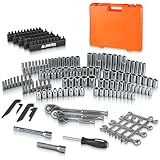
Overview: The JU JIAN TEC 201-Piece Mechanics Tools Set is a comprehensive solution for both professional mechanics and serious DIY enthusiasts. This extensive collection covers three drive sizes (1/4", 3/8", and 1/2") with both SAE and Metric measurements, providing versatility for automotive, motorcycle, and home repair applications. The set combines sockets, ratchets, wrenches, hex keys, and specialty bits in one organized package.
What Makes It Stand Out: This set’s remarkable comprehensiveness stands out, offering 85 sockets across all drive sizes plus 55 driver bits, 28 hex keys, and combination wrenches. The premium chrome vanadium steel construction ensures durability under high torque loads, while the 72-tooth ratchet mechanism with push-button release provides professional-grade performance. The blow-molded case features size labeling for each tool, eliminating frustration and simplifying inventory management.
Value for Money: For a mid-range price point, this 201-piece set delivers exceptional breadth that would cost significantly more if purchased separately. The inclusion of impact-rated sockets adds versatility for pneumatic tool use, while the organized case saves time and prevents loss. Compared to piecing together individual components from premium brands, this set offers 80% of the quality at 50% of the cost, making it ideal for budget-conscious professionals.
Strengths and Weaknesses: Pros: Extensive 201-piece coverage; three drive sizes; SAE and Metric; impact socket capability; organized labeled case; CRV steel construction; quick-release ratchets. Cons: Bulkier case reduces portability; some users report case durability concerns; brand recognition lower than established names; may include sizes rarely used by hobbyists.
Bottom Line: This JU JIAN TEC set represents one of the best values for building a complete mechanic’s arsenal without breaking the bank. While professionals might eventually upgrade frequently-used pieces to premium brands, this collection provides everything needed to tackle 95% of automotive and equipment repairs. Perfect for serious DIYers, apprentices, and mobile mechanics needing comprehensive coverage.
8. AMM Mechanics Tool Set, 1/4 in, 3/8 in and 1/2 in Drive socket set, 202 Piece

Overview: The AMM 202-Piece Mechanics Tool Set positions itself as a comprehensive solution for automotive enthusiasts and professional mechanics alike. Covering the three most common drive sizes—1/4-inch, 3/8-inch, and 1/2-inch—this collection includes both SAE and Metric sockets, ratchets, wrenches, hex keys, and specialty bits. The tools are forged from chrome-vanadium steel and finished with full-polish chrome for corrosion resistance, all housed in a high-hardness toolbox designed for durability.
What Makes It Stand Out: AMM distinguishes itself through exceptional organizational features and customer service commitment. The toolbox features clear size markings for each tool location, dramatically reducing search time and improving workflow efficiency. The 72-tooth ratchet mechanism provides professional-grade performance with a minimal 5-degree swing arc. Additionally, AMM offers all-day customer service support, providing peace of mind rarely found with lesser-known brands in this category.
Value for Money: This set competes directly with similar 200+ piece offerings at a compelling price point. The high-hardness toolbox adds durability that cheaper blow-molded cases often lack, potentially extending the set’s service life. For automotive enthusiasts building their first comprehensive kit, this represents a solid middle-ground option—more robust than budget brands but more affordable than premium names like Snap-on or Mac Tools.
Strengths and Weaknesses: Pros: Comprehensive 202-piece coverage; three drive sizes; SAE and Metric; durable high-hardness case; size markings for organization; chrome-vanadium steel construction; responsive customer service. Cons: Brand recognition limited compared to legacy manufacturers; case weight reduces portability; some users may find the tool layout takes time to memorize; ratchet refinements may not match premium brands.
Bottom Line: The AMM 202-piece set is an excellent choice for serious DIY mechanics and entry-level professionals seeking comprehensive coverage without premium pricing. The organizational features and customer service support add significant value, while the robust construction ensures durability. Consider this set if you prioritize organization and support over brand prestige, and need a reliable, all-in-one solution for automotive and equipment maintenance.
9. Beaiguna 46PCS Small Drive Socket Ratchet Wrench Screwdriver Set, 1/4 Inch Metric Socket and Ratchet Wrench Set with Extension Bar, Upgrade Compact Tool Set for Car

Overview: The Beaiguna 46-piece set is a compact, metric-focused tool kit designed for portability and emergency repairs. This streamlined collection centers around 1/4-inch drive sockets ranging from 4mm to 14mm, complemented by an extensive 21-piece bit selection and multiple drive accessories including a flexible extension and universal joint. The entire kit packs into a small case with foam inserts, making it ideal for glovebox storage or mobile technicians.
What Makes It Stand Out: This set’s ultra-compact design is its primary differentiator. The inclusion of a flexible extension and universal joint in such a small kit provides versatility typically found in larger sets. The quick-release ratchet with reversible mechanism offers professional convenience, while the foam-insert case prevents tool rattle and loss during transport. High-density carbon steel construction provides durability exceeding expectations for this price tier and size category.
Value for Money: As one of the most affordable options in the mechanics tool market, this set delivers remarkable utility for emergency and light-duty applications. While unsuitable as a primary garage set, it costs less than a single premium ratchet while providing comprehensive metric coverage for common automotive fasteners. For motorcyclists, cyclists, or drivers wanting emergency preparedness, this represents unbeatable value and space efficiency.
Strengths and Weaknesses: Pros: Extremely compact and portable; includes flexible extension and universal joint; metric-focused for modern vehicles; foam-insert case prevents loss; affordable price point; quick-release reversible ratchet. Cons: Limited to 1/4-inch drive; metric-only restricts versatility; socket range limited to 14mm maximum; carbon steel may not match CRV durability; not suitable for heavy-duty applications.
Bottom Line: The Beaiguna 46-piece set excels as a specialized emergency and mobile repair kit. It’s perfect for motorcyclists, roadside assistance, or as a supplemental set for tight spaces. While not robust enough for professional daily use, its portability and thoughtful accessory selection make it an essential companion for anyone needing reliable metric fasteners on the go. Purchase this for convenience and emergency preparedness, not as your primary tool arsenal.
10. VEVOR Mechanics Tool Set and Socket Set, 1/4" 3/8" 1/2" Drive Deep and Standard Sockets, 450 Pcs SAE and Metric Mechanic Tool Kit with Bits, Combination Wrench, Hex Wrenches, Accessories, Storage Case

Overview: The VEVOR 450-Piece Mechanics Tool Set represents the pinnacle of comprehensive tool collections for serious professionals and dedicated DIY enthusiasts. This massive assortment covers every conceivable fastener need with deep and standard sockets in three drive sizes, both SAE and Metric measurements, plus an extensive array of bits, combination wrenches, hex keys, and accessories. Forged from CR-V chrome-plated steel and rated for torque from 95 to 3017 in-lb, this set is built for demanding applications.
What Makes It Stand Out: The sheer scale of this set is unprecedented at its price point, offering professional-grade breadth that rivals tool truck brands costing ten times more. The specified torque ratings demonstrate engineering confidence rarely seen in comprehensive kits. The lightweight PE-HD storage case provides durability without the weight penalty of metal boxes, while maintaining organized compartments for all 450 pieces. This combination of capacity, performance data, and manageable portability creates a unique market position.
Value for Money: Despite being the highest-priced option reviewed, this set delivers extraordinary value when calculated on a per-piece basis. The CR-V steel construction and verified torque ratings ensure these tools can handle professional daily use, eliminating the need for future upgrades. For shop owners, fleet mechanics, or serious hobbyists building a lifetime collection, this single purchase replaces years of incremental buying, saving thousands compared to premium brand equivalents.
Strengths and Weaknesses: Pros: Massive 450-piece comprehensive coverage; CR-V steel construction; specified torque ratings (95-3017 in-lb); deep and standard sockets; three drive sizes; SAE and Metric; lightweight durable case; professional-grade breadth. Cons: Higher initial investment; overwhelming for casual users; case size requires substantial storage space; brand lacks legacy prestige; some pieces may see infrequent use.
Bottom Line: The VEVOR 450-piece set is an investment-grade tool collection for professionals and serious enthusiasts who demand comprehensive coverage and proven performance. While overkill for occasional home use, it provides everything needed for automotive, machinery, and equipment repair in one purchase. If you’re building a shop or want to avoid piecemeal tool acquisition, this set offers unparalleled value and capability that will serve you for decades.
Understanding Socket Set Basics for Weekend Warriors
What Makes a Socket Set “Weekend Mechanic” Grade?
The term “weekend mechanic” doesn’t imply inferior quality—it defines a specific use case. You’re not turning wrenches eight hours a day, five days a week, but when you do work, you need reliability. Professional-grade tools offer durability for daily abuse, but they often come with premium pricing that doesn’t make sense for occasional use. Weekend mechanic-grade sets strike a balance: robust enough to handle serious torque without failure, yet sensibly priced for the DIY enthusiast who’d rather spend money on parts than tools.
The key differentiator isn’t just material thickness; it’s thoughtful design. These sets typically include the most commonly used sizes while omitting obscure professional-only pieces. They feature ratchets with smoother mechanisms than bargain-bin options but may skip the ultra-high tooth counts that master technicians demand for accessing tight spaces in modern engine bays. Think of it as the sweet spot between disposable junk and overbuilt professional equipment you’ll never fully utilize.
Drive Sizes Demystified: 1/4", 3/8", and 1/2" Explained
Drive size determines the torque capacity and access capabilities of your socket set. The 1/4-inch drive handles precision work—think interior trim, electronics, and small engine components. Its compact head fits where larger ratchets can’t, but it can’t safely handle suspension bolts or lug nuts. For weekend mechanics, this drive size is essential but shouldn’t dominate your collection.
The 3/8-inch drive is your workhorse. It covers roughly 80% of automotive tasks, from removing valve covers to swapping alternators. Most weekend mechanics should build their primary collection around this size, as it offers the best compromise between access and strength. The 1/2-inch drive handles heavy-duty tasks—suspension work, crankshaft bolts, and tire changes. While you won’t use it every weekend, when you need it, nothing else suffices. Smart sets include all three drives, but prioritize socket count in the 3/8-inch range.
Metric vs. SAE: Which System Do You Actually Need?
Your vehicle’s origin story dictates your socket system needs. Modern American cars (post-1980s) predominantly use metric fasteners, despite what traditionalists claim. Japanese and European vehicles are exclusively metric. Classic American iron—muscle cars, trucks from the ’70s and earlier—requires SAE (Society of Automotive Engineers) sizes. The frustrating reality? Most home garages eventually need both.
Rather than buying two complete sets, consider a mixed set with emphasis on your primary vehicle type. If you wrench on a 2010 Honda Civic, allocate 70% of your budget to metric sockets. Own a ‘69 Camaro? Flip that ratio. Many manufacturers now offer “universal” sets with both systems, but these often skimp on less-common sizes in each category. The savvy approach: start with a quality mixed set, then supplement with individual sockets in the sizes you use most frequently.
Essential Socket Types Every Home Garage Needs
Deep vs. Standard Sockets: Making the Right Choice
Standard (or shallow) sockets excel in open spaces where bolt threads don’t extend far beyond the nut. They’re lighter, cheaper, and provide better feel in accessible locations. Deep sockets reach over long threaded sections—common on suspension components, exhaust hangers, and certain engine mounts. For weekend mechanics, a 2:1 ratio of standard to deep sockets offers the best versatility.
The mistake many make is assuming deep sockets can do everything standard sockets can. They can’t. Deep sockets in tight spaces often can’t seat fully on the fastener, increasing slip and rounding risk. They also flex slightly more under torque, reducing precision. Your set should include both types in common sizes, but prioritize standard sockets for your initial purchase. Deep sockets become valuable as you tackle more complex projects.
Impact Sockets: When Power Tools Enter the Equation
Impact sockets aren’t just thicker versions of regular sockets—they’re fundamentally different. Made from softer, more ductile steel (typically chrome molybdenum rather than chrome vanadium), they absorb impact tool vibrations without shattering. Using standard sockets with impact wrenches risks catastrophic failure that can cause serious injury. The steel becomes brittle under repeated impacts, potentially sending shards flying at eye-level.
For weekend mechanics, a small set of impact sockets in common lug nut and suspension bolt sizes proves invaluable. You don’t need the full range, but 17mm, 19mm, and 21mm (or their SAE equivalents) will handle most wheel and suspension tasks. Pro tip: impact sockets have thicker walls, so they may not fit in extremely tight spaces where hand tools excel. Keep your chrome vanadium set for precision work and your impact set for brute force applications.
Specialty Sockets: Torx, E-Torx, and Beyond
Modern vehicles increasingly use Torx (star-shaped) and E-Torx (external Torx) fasteners, especially in German cars and on critical components like brake calipers and drivetrain parts. Ignoring these patterns limits your capabilities significantly. A weekend mechanic set should include the most common sizes: T40, T45, T50 for internal Torx, and E10, E12, E14 for external.
Beyond Torx, consider spline sockets for stripped bolt removal and hex bit sockets for Allen-head fasteners common on motorcycle and bicycle components. The key is avoiding the “specialty socket trap”—buying obscure sizes you’ll use once a decade. Focus on patterns that appear repeatedly in your specific vehicles’ service manuals. Online communities for your car model can provide invaluable guidance on which specialty bits see actual use.
Material Matters: Chrome Vanadium vs. Chrome Molybdenum
Understanding Socket Construction Quality
Chrome vanadium (Cr-V) steel dominates hand tool sockets for good reason. It offers excellent strength-to-weight ratio, good wear resistance, and maintains dimensional stability under typical torque loads. Quality Cr-V sockets typically measure 50-53 HRC (Hardness Rockwell C), hard enough to resist deformation but not so brittle that they’ll crack under stress. For weekend mechanics, this material hits the performance-price sweet spot.
Chrome molybdenum (Cr-Mo) appears primarily in impact sockets. The molybdenum addition increases toughness and ductility, allowing the socket to flex slightly under impact loads rather than fracture. While you can use Cr-Mo sockets by hand, they’re overkill for most applications and often cost more. The softer material also wears faster in hand-tool use. Stick with Cr-V for your primary ratchet-and-socket work, reserving Cr-Mo for dedicated impact applications.
Finish Types and Corrosion Resistance
That mirror-like chrome finish does more than look pretty—it provides a sacrificial barrier against rust. Quality sockets undergo multiple plating processes: copper for adhesion, nickel for hardness, and chrome for corrosion resistance and easy cleaning. However, not all chrome finishes are equal. Thin, cheap plating flakes off under use, exposing bare steel to moisture and skin oils.
For home garage environments (often humid, sometimes unheated), prioritize full-polish chrome finishes. Matte or satin finishes hide scratches better but can trap moisture in microscopic surface imperfections. Black oxide finishes, common on impact sockets, offer minimal corrosion protection and require regular oiling. Consider your storage conditions: if your garage sees temperature swings that create condensation, full-polish chrome pays dividends in longevity.
Case and Organization: The Overlooked Deal-Breaker
Blow-Molded Cases vs. Soft Storage
That sturdy-looking plastic case might seem like a bonus, but many weekend mechanics eventually abandon them. Blow-molded cases keep sockets organized during shipping and store displays, but they’re bulky and often waste space. Worse, if a single socket goes missing, the empty cavity taunts you forever. The clips that hold sockets weaken over time, leading to sockets falling out every time you open the case.
Soft-sided tool rolls or drawer organizers often serve weekend mechanics better. They conform to available space, make individual sockets easily visible, and expand gracefully as you add pieces. If you must have a hard case, look for ones with removable trays that can transition to drawer storage. Some premium sets feature modular cases where you can rearrange socket holders or remove empty spaces—a thoughtful touch that acknowledges real-world use.
Keeping Your Investment Organized
A disorganized socket set is a useless socket set. Weekend mechanics face a unique challenge: months between projects allow ample time for tools to migrate across the garage. Implement a “home for every socket” system from day one. Label drawers with size ranges, use socket rails for frequently-used drives, or invest in foam organizers that clearly show missing pieces.
Consider color-coding: electrical tape rings in different colors can distinguish metric from SAE at a glance. Some mechanics paint drive size indicators on socket bases—red for 1/4", blue for 3/8", green for 1/2". This visual system prevents grabbing the wrong socket in dim garage lighting. Remember, organization isn’t about being neat; it’s about efficiency. Every minute spent hunting for a 15mm socket is a minute you’re not spending on the satisfying work of actually fixing your car.
Tooth Count and Ratchet Mechanisms
72-Tooth vs. 90-Tooth Ratchets: Does It Matter?
Tooth count determines how small a swing arc you need to engage the next tooth. A 72-tooth ratchet requires just 5 degrees of movement, invaluable when working in cramped engine bays where you can’t get a full swing. A 45-tooth ratchet needs 8 degrees—seemingly minor, but the difference between cursing and contentment when wedged against a firewall.
For weekend mechanics, 72-tooth ratchets offer the best value. They provide smooth operation without the premium price of 90-tooth or higher mechanisms. Those ultra-fine ratchets, while glorious to use, demand tighter manufacturing tolerances that increase cost significantly. The marginal benefit rarely justifies the expense for occasional use. Focus instead on ratchet durability—a well-built 72-tooth mechanism outperforms a cheap 90-tooth ratchet that develops play after six months.
Quick-Release and Flex-Head Features
Quick-release buttons seem like a minor convenience until you use them. They prevent the maddening scenario of a socket stuck on a bolt, requiring pliers to remove. However, cheap quick-release mechanisms fail, leaving you with a permanently locked socket. Look for solid, positive engagement when pressing the button—mushy action signals poor internals.
Flex-head ratchets angle up to 90 degrees, accessing bolts around corners and in tight spaces. They’re indispensable for certain jobs (serpentine belt tensioners, some exhaust bolts) but sacrifice some strength and precision. For weekend mechanics, one flex-head 3/8" ratchet covers most needs. Avoid sets where every ratchet is flex-head; standard fixed heads provide better feedback and control for general use. The ideal collection includes one fixed and one flex-head in your primary drive size.
Warranty and Brand Reputation
Lifetime Warranties: Reading the Fine Print
“Lifetime warranty” sounds straightforward until you try to claim it. Many brands warranty against manufacturing defects but exclude normal wear, rust, or damage from misuse. The distinction matters: a socket that cracks from material fatigue is covered; one rounded from using a pipe for extra leverage is not. Some warranties require original receipts and registration within 30 days—details weekend mechanics often miss.
Research warranty claim processes before buying. Brands with easy, no-questions-asked replacement at any retailer offer true peace of mind. Others require shipping items back at your expense, waiting weeks for evaluation. For tools you depend on, a hassle-free warranty beats a “comprehensive” one that’s pain to use. Check online forums for real-world claim experiences; manufacturers’ marketing promises often differ from reality.
Budget vs. Premium Brands for Occasional Use
The $30 socket set at the discount store might tempt you, but consider the hidden costs. Cheap sockets often have sloppy tolerances—slightly oversized internal dimensions that round fasteners, turning a simple job into an extraction nightmare. Their ratchets develop play quickly, and replacement under warranty requires finding that receipt from three years ago.
That said, premium professional brands sometimes price-gouge for marginal improvements weekend mechanics won’t notice. The sweet spot lies in mid-tier brands that prioritize quality where it matters (ratchet mechanisms, socket hardness) while skipping luxury features like laser-etched size markings that wear off anyway. Look for brands that offer professional lines and weekend warrior lines from the same factory—often the same quality control with fewer pieces.
The 10-Piece vs. 100-Piece Dilemma
Right-Sizing Your Socket Set
Manufacturers love advertising piece counts, but a 100-piece set might contain 30 bits you’ll never use and 20 duplicates across drive sizes. Weekend mechanics should focus on coverage, not quantity. A well-curated 30-piece set often outperforms a bloated 100-piece collection. The essential automotive socket collection includes: 8mm-19mm in both standard and deep for metric, or 5/16" to 3/4" for SAE, plus your three drive sizes.
The piece-count game includes tricks like counting the case, extension bars, and even the manual as separate pieces. Read the actual socket list. A set with 25 sockets you need beats one with 50 sockets where half are obscure sizes or low-quality screwdriver bits included to inflate the number. Start lean; you can always add individual sockets as projects demand them.
Expansion Possibilities and Add-Ons
Smart socket set design allows growth. Look for brands that sell individual sockets matching set finishes and drive systems. Some manufacturers use proprietary socket rail systems, locking you into their ecosystem. While convenient, this limits future flexibility. Standard square drive sockets work with any ratchet, giving you freedom to mix brands.
Consider socket sets with “pass-through” designs or those that accommodate future impact socket additions. Some cases include empty slots for expansion, though as noted earlier, this feature often proves more frustrating than useful. The best expansion strategy: buy into a brand with consistent sizing and readily available individual sockets at local retailers. When you need that one oddball size at 9 PM on a Saturday, driving to a store beats waiting for shipping.
Safety Considerations for Home Mechanics
Avoiding Socket Failure and Injury
Socket failure rarely happens quietly. A cracked socket under torque can send metal flying, and a ratchet that suddenly slips can smash knuckles into sharp engine components. Weekend mechanics, often working alone, must prioritize safety even more than professionals who have coworkers nearby. Never use damaged sockets—cracks, even hairline ones, propagate under stress.
The most dangerous practice is using standard sockets with impact tools. The hardened steel can shatter like glass, creating shrapnel. Similarly, using adapters to fit a 1/2" socket on a 1/4" ratchet concentrates stress dangerously. Respect drive size limitations: 1/4" drive for light work, 3/8" for general use, 1/2" for heavy torque. When a bolt won’t budge with your 3/8" drive, switch to 1/2" instead of cheating with a pipe on the ratchet handle.
Proper Torque and Socket Matching
Socket walls have thickness limits; forcing a metric socket on a similar SAE fastener (or vice versa) damages both tool and bolt. The “close enough” approach works exactly once—then you’re buying bolt extractors. Always verify socket fit: it should slide on easily with minimal play. A socket that’s too loose will round the fastener; one that’s too tight stresses the socket walls.
Torque matters. Weekend mechanics often lack torque wrenches, leading to two dangerous extremes: undertightening critical fasteners (wheel lug nuts, brake caliper bolts) or overtightening everything else. Invest in a decent click-type torque wrench before buying your third socket set. Using sockets properly means matching them to the right fastener and applying appropriate force—not just what feels right.
Price Points and Value Assessment
Decoding the $30 vs $300 Socket Set
That $30 set might seem like a steal, but analyze the per-socket cost. Cheap sets often include 40+ pieces, but the sockets are thin-walled, the ratchet has 45 teeth and feels gritty, and the case breaks within a year. Divide the price by the number of sockets you’ll actually use—suddenly it’s not so cheap. A $300 set with 30 high-quality sockets you use constantly offers better value.
The $300 set’s price includes research and development, tighter manufacturing tolerances, and better materials. You’re paying for consistency: every socket fits perfectly, every time. For weekend mechanics, the middle ground ($80-$150) typically delivers professional-grade ratchets and commonly-used sockets, with some compromises on less-frequent sizes. This range avoids both the frustration of junk tools and the diminishing returns of professional-grade equipment used twice a month.
Where to Invest vs. Where to Save
Invest in your primary drive ratchet. A smooth, reliable 3/8" ratchet transforms every job. Spend money on common socket sizes—10mm, 13mm, 15mm for metric; 1/2", 9/16", 5/8" for SAE. These see 80% of use and deserve quality. Save money on deep sockets in uncommon sizes, specialty bits you might use once, and 1/4" drive pieces where precision matters less than access.
Consider buying a premium ratchet separately and pairing it with a mid-tier socket set. Ratchet mechanisms wear out faster than sockets and benefit most from quality engineering. Sockets are simpler; a decent mid-range socket often performs identically to a premium one. Extensions and adapters? Mid-tier is fine. Breaker bars? Spend extra—when you need one, you’re applying enough force that failure becomes dangerous.
Maintenance and Longevity Tips
Cleaning and Storage Best Practices
After each project, wipe sockets with a rag soaked in WD-40 or light oil. This removes corrosive brake dust, road salt, and skin acids. Don’t return dirty sockets to the case—they’ll rust and contaminate clean ones. For stubborn grime, soak in parts washer solvent, then dry thoroughly. Never use abrasive pads on chrome finishes; they create micro-scratches that trap moisture.
Store sockets in a climate-controlled environment if possible. Garages with wide temperature swings create condensation, promoting rust. Silica gel packets in your case or drawer absorb moisture. For long-term storage, lightly coat sockets in oil. Check stored sets every few months—catching surface rust early prevents pitting. Your tools should outlast your car; proper maintenance makes that possible.
When to Retire a Socket
A socket’s lifespan isn’t infinite. Retire any socket that shows visible cracking, wall spreading (where the square drive hole becomes loose), or internal rounding. Test fit on a new bolt: if it wobbles noticeably, it’s worn. Deep sockets with bent or deformed tips can’t seat properly and should be discarded.
Ratchets need retirement when they develop significant play in the gear teeth or when the quick-release mechanism fails. A ratchet that skips under load is dangerous. Don’t keep damaged tools “just in case”—the case will be an emergency where you need reliable performance. Weekend mechanics can justify keeping old sockets for sacrificial tasks (welding a nut to a stripped bolt for extraction), but mark them clearly and store them separately from your working set.
Digital Innovation in Socket Sets
Smart Torque and Measurement Features
Bluetooth-enabled torque adapters now fit between your ratchet and socket, providing digital readouts on your phone. For weekend mechanics, this tech bridges the gap between “feeling tight” and actual spec. Some systems log torque values, helpful when you’re interrupted mid-job and forget which bolts you’ve tightened. However, they add length to your tool, reducing access in tight spaces.
Digital calipers integrated into socket sets remain largely gimmicky. The precision is unnecessary for most automotive work, and the electronics fail in greasy, vibrating environments. Where digital tools shine is in learning: seeing actual torque values helps develop feel for proper tightness. Once you’ve built that muscle memory, the digital crutch becomes less necessary. Consider these training wheels for your first year of serious wrenching.
Bluetooth-Enabled Tools: Gimmick or Game-Changer?
Smart socket sets that track which socket you’ve selected sound futuristic but solve a problem weekend mechanics rarely face—professional billing and inventory management. The added cost and complexity (charging batteries, app updates) rarely justify the benefit for home use. However, some high-end sets now include RFID tagging for warranty registration and theft recovery, which has practical value.
The real innovation lies in torque wrenches with digital angle measurement, crucial for modern “torque-to-yield” fasteners. While not strictly socket set features, they integrate with your sockets and represent where tool technology genuinely advances. For weekend mechanics, these remain luxury items until you start rebuilding modern engines with stretch bolts. Focus budget on fundamental quality before chasing digital features.
Buying New vs. Vintage Socket Sets
The Appeal of Classic American Steel
Vintage Craftsman, Snap-on, and Proto sockets from the 1960s-1980s often outperform modern budget tools. Made from high-quality American steel with exceptional quality control, these tools feature thicker walls and more precise internals than contemporary equivalents. Garage sales and estate auctions can yield incredible deals—full sets for the price of a single modern premium socket.
However, vintage tools lack modern conveniences like quick-release ratchets and high tooth counts. Their finish may be worn, and warranty support is non-existent. More importantly, they won’t include modern sizes like 10mm or Torx bits. The sweet spot? Use vintage tools to supplement a modern core set. That indestructible 1/2" drive Craftsman ratchet from 1975 pairs perfectly with a new socket set, giving you vintage durability where it matters.
What to Watch for in Second-Hand Tools
Inspect used sockets for wall spreading by testing the square drive fit. It should be snug, not sloppy. Check for cracks at the corners of the drive hole—these propagate from impact use. Avoid sockets with significant rust pitting; it’s not just cosmetic but weakens the structure. For ratchets, test the mechanism repeatedly; it should feel smooth, not gritty or sticky.
Estate sales from professional mechanics often yield the best tools, but be wary of items that saw daily abuse. A socket used daily for 20 years is likely near end-of-life, while one used occasionally might have decades left. Price matters: a full vintage set at 30% of new cost makes sense; at 70%, just buy new with warranty. Always factor in replacement costs for any missing or damaged pieces.
Socket Set Accessories That Actually Matter
Extensions, Adapters, and Universal Joints
Extensions transform socket accessibility, but quality varies dramatically. Cheap extensions wobble at the connection, converting your torque into wasted motion. Look for ball-detent mechanisms that lock securely but release smoothly. A 3" and 6" extension in each drive size covers most needs; 10" and wobble extensions solve specialized problems but see less frequent use.
Adapters (1/4" to 3/8", 3/8" to 1/2") multiply your set’s versatility but introduce weak points. Never use adapters for high-torque applications—they concentrate stress and can fracture. Universal joints (swivel sockets) access bolts at angles, but they flex under torque, reducing precision. Use them for initial loosening or final tightening, then switch to straight extensions for the main torque application. One quality universal joint per drive size suffices for weekend mechanics.
The Role of Breaker Bars in Your Collection
A breaker bar isn’t a socket, but it’s the most important accessory for your 1/2" drive sockets. When bolts refuse to budge, reaching for a longer ratchet handle risks breaking the ratchet mechanism. Breaker bars have no gears to damage—just pure leverage. A 18-24" breaker bar pays for itself the first time you remove a rusted suspension bolt without destroying your ratchet.
Don’t use cheater pipes on ratchets; use a breaker bar designed for the force. Quality breaker bars have swivel heads that allow optimal positioning and prevent socket binding. For weekend mechanics, this single tool extends the life of your entire socket set by handling the abuse that would otherwise destroy your ratchets. It’s insurance that costs less than replacing one premium ratchet.
Common Mistakes Weekend Mechanics Make
Overbuying Before Understanding Needs
The enthusiast’s first purchase is often a massive 300-piece set containing every size imaginable. Six months later, they use maybe 20 pieces regularly while the rest occupy valuable drawer space. Start with a quality core set, then add specific pieces as projects demand them. Your needs become clear through experience, not speculation.
Another trap: buying professional-grade everything. That $400 ratchet set won’t make you a better mechanic; practice will. Invest in skills first, tools second. Take a community college auto class, watch experienced mechanics work, learn proper technique. A skilled mechanic with basic tools outperforms a novice with a pro shop’s inventory. Tools amplify skill; they don’t replace it.
Ignoring Drive Size Compatibility
Mixing drive sizes through adapters seems efficient but creates safety hazards. That 1/4" drive ratchet was never meant to handle the torque a 1/2" socket can apply. The square drive can fracture, sending metal flying. Similarly, using a 1/2" ratchet with a 1/4" socket via adapter gives poor control and risks snapping the smaller socket.
Respect each drive size’s intended purpose. If you find yourself constantly adapting up or down, you need a better selection in that drive size. The exception: 3/8" to 1/4" adapters for occasional use in tight spaces where a full-size 3/8" ratchet won’t fit. For regular use, buy the proper drive size. Your safety and the longevity of your fasteners depend on it.
Making Your Final Decision
Creating a Personal Checklist
Before clicking “buy,” inventory your current tools and upcoming projects. List your vehicles and their specific needs. A Jeep owner needs more 1/2" drive sockets for suspension work; a Miata enthusiast prioritizes 3/8" drive for the tight engine bay. Check online forums for your vehicle model—search “essential socket sizes” plus your car’s name. This research prevents buying sets missing critical sizes.
Set a realistic budget based on use frequency. If you wrench every weekend, spending $200 on a quality set amortizes to pennies per use. If you change oil twice a year, a $80 set makes more sense. Factor in future expansion: will this brand’s individual sockets be available when you need them? Does the retailer offer easy returns? Your checklist should include warranty terms, case type, included sizes, and brand reputation for your specific use case.
Where to Shop for the Best Deals
Big-box retailers offer convenience and easy returns but limited selection beyond mainstream brands. Online marketplaces provide infinite choice but require careful seller vetting to avoid counterfeits. Tool trucks (Snap-on, Matco) sell premium gear with excellent warranties but at prices that rarely make sense for weekend use. Their value lies in trying tools before buying—a 3/8" ratchet that feels perfect in your hand is worth a premium.
Watch for holiday sales, especially Father’s Day and Black Friday, when quality mid-tier sets drop 30-40%. Consider buying last year’s model; socket design changes minimally year-to-year. Local pawn shops sometimes harbor professional-grade tools at steep discounts, but inspect carefully for wear. The best deal isn’t always the lowest price—it’s the right tool at a fair price from a retailer who stands behind it.
Frequently Asked Questions
What’s the minimum number of pieces I need to start working on my car?
A functional starter set includes 20-25 sockets: 8mm-19mm in standard depth (skipping 9mm and 11mm which are rare), a 3/8" ratchet, 3" and 6" extensions, and a universal joint. Add a 1/2" drive breaker bar and sockets in 17mm, 19mm, and 21mm for wheels. This covers 90% of basic maintenance tasks.
Can I mix different brands of sockets and ratchets?
Absolutely. The square drive standard is universal across brands. Mixing allows you to buy the best ratchet your budget allows while choosing sockets based on value. The only consideration is warranty—some brands require using their complete system to honor claims, though this is rare. Functionally, a Snap-on ratchet works perfectly with Tekton sockets.
How do I know if a socket is truly “impact rated”?
Impact sockets are typically black (from oxide finish) and visibly thicker-walled than hand sockets. They’ll be marked “impact” or have “Cr-Mo” stamped on them. Hand sockets are usually chrome-plated and marked “Cr-V.” Never assume based on color alone—some hand sockets come in black finishes now. Check the material specification.
Why do my sockets keep rusting in my garage?
Garage humidity fluctuates with outdoor temperature changes, creating condensation on cold metal tools. Store sockets with silica gel packs, wipe them with oil after use, and consider a dehumidifier for your tool storage area. Full-polish chrome finishes resist rust better than matte finishes. If rust appears, remove it immediately with fine steel wool and oil before pitting develops.
Is it worth buying a set with both metric and SAE if I only work on Japanese cars?
Even Japanese cars occasionally have SAE fasteners, especially aftermarket parts. A small SAE set (5/16" to 3/4") costs little and prevents being stranded mid-job. However, prioritize metric quality. Buy a comprehensive metric set first, then add a budget SAE set later. The reverse applies if you work on classic American vehicles.
What’s the deal with 6-point vs. 12-point sockets?
6-point sockets contact fastener flats, reducing rounding risk and handling higher torque. 12-point sockets fit in tighter spaces (every 30 degrees vs. every 60 degrees) but are more likely to round bolts. For weekend mechanics, 6-point sockets are superior for almost all applications. Only use 12-point when access absolutely requires it, and never for high-torque or damaged fasteners.
How often should I replace my socket set?
Quality sockets last decades with proper care. Replace individual pieces as they wear or break, not the entire set. Ratchets may need rebuilding every 5-10 years of weekend use. The set only needs complete replacement if you’re switching drive systems or if the brand’s individual replacement pieces become unavailable. Tools don’t expire; they wear out individually.
Can I use my socket set for non-automotive projects?
Absolutely, but consider the contamination risk. Using automotive sockets on greasy, rusty projects then returning them to your clean set transfers grit that accelerates wear. Many mechanics maintain a separate “beater” set for home repairs and dirty work, preserving their good automotive set. The same principles apply: match socket to fastener, respect torque limits, clean after use.
What’s the best way to organize sockets if I hate the original case?
Socket rails that mount in drawers offer the best visibility and access. Label each rail with size ranges. Magnetic socket holders attach to toolboxes or workbenches, keeping frequently-used sizes handy. Foam organizers in drawers clearly show missing pieces but take up more space. Avoid dumping sockets in a drawer—size identification becomes nearly impossible with greasy hands.
How do I avoid buying counterfeit sockets online?
Purchase from authorized retailers or directly from manufacturers. On marketplaces, check seller ratings and reviews specifically mentioning authenticity. Counterfeit sockets often have misspelled markings, poor chrome finish, and incorrect weights. If a deal seems too good to be true on premium brands, it is. When in doubt, buy from local stores where you can inspect before purchasing.
See Also
- 10 Best Value Socket Sets for Home Mechanics in 2026
- 10 Game-Changing Socket Sets for Weekend Warriors in 2026
- 10 Premium Socket Sets for Professional Mechanics (Worth the Investment)
- The 10 Ultimate Best Socket Sets for Home Mechanics in 2026
- The 10 Ultimate Best Socket Sets for Mechanics in 2026