Table of Contents
Top 10 Cordless Rotary Hammers For Concrete
Detailed Product Reviews
1. Seesii Cordless SDS-Plus Rotary Hammer Drill for Concrete, 2 × 4.0Ah Batteries, Includes 3 Drill Bits, Flat & Point Chisels, Lightweight Power Tool for Home Improvement, DIY & Masonry
, DIY & Masonry](https://m.media-amazon.com/images/I/517YIHFHXJL._SL160_.jpg)
Overview: The Seesii Cordless SDS-Plus Rotary Hammer Drill targets DIYers and homeowners tackling concrete, masonry, or general home projects. It delivers substantial power with 2.1J impact energy and includes dual 4.0Ah batteries, essential bits, and chisels in a lightweight 2.3kg package.
What Makes It Stand Out: Its 4-in-1 functionality (drill-only, hammer-only, hammer-drill, adjustable chisel) offers exceptional versatility for diverse tasks. The dual high-capacity batteries ensure extended runtime, while the ergonomic 360° handle, LED work light, and Makita-compatible battery system enhance usability and convenience for cordless operation.
Value for Money: Priced competitively, it includes significant extras—two large batteries, multiple bits, chisels, and a case—making it a strong value against bare-tool competitors. The inclusion of features typically found in pricier models justifies the cost for DIY-focused users needing a complete, ready-to-work solution.
Strengths and Weaknesses: Strengths: Excellent versatility with 4 modes; lightweight and ergonomic; generous battery/ammo bundle; bright LED light; broad battery compatibility. Weaknesses: Brand reputation less established than industry leaders; vibration control not as advanced as premium Dewalt counterparts; potential durability questions for heavy professional use.
Bottom Line: An outstanding, feature-packed choice for DIYers and light-duty home projects seeking cordless freedom, versatility, and a complete kit without breaking the bank. Highly recommended for non-professional concrete work.
2. DEWALT 20V MAX SDS Plus Rotary Hammer Drill, Cordless, 5/8 in., Tool Only (DCH172B), Special Feature Brushless Motor, Compact, Cordless

Overview: The DEWALT DCH172B is a professional-grade, bare tool cordless SDS-plus rotary hammer designed for contractors. It focuses on efficient concrete drilling (1.4J impact energy) in applications like conduit mounting and railing installation, prioritizing compactness and runtime.
What Makes It Stand Out: DEWALT’s brushless motor and German-engineered mechanism optimize power and battery life. Its standout feature is the SHOCKS Active Vibration Control, significantly reducing user fatigue during prolonged use. OSHA Table 1 compliance (with specific dust accessories) is crucial for jobsite safety regulations.
Value for Money: As a bare tool, it requires separate battery investment, raising initial costs. However, the premium brushless tech, superior vibration control, and OSHA compliance deliver exceptional long-term value for professionals through enhanced durability, user comfort, and regulatory adherence, justifying its higher price point.
Strengths and Weaknesses: Strengths: Industry-leading SHOCKS vibration reduction; reliable brushless motor for runtime/durability; compact and lightweight (ideal for overhead work); OSHA Table 1 compliant with add-ons; trusted DEWALT build quality. Weaknesses: Lower 1.4J impact energy vs. some rivals; bare tool only (no batteries/accessories); higher upfront cost without included kit.
Bottom Line: A top-tier professional tool for contractors prioritizing vibration control, durability, and regulatory compliance. Essential for frequent concrete work despite the bare-tool cost; highly recommended for serious tradespeople.
3. DEWALT 20V MAX SDS Rotary Hammer Drill, Cordless, 3 Application Modes, Bare Tool Only (DCH273B)

Overview: The DEWALT DCH273B is a high-performance bare tool cordless SDS rotary hammer targeting professionals needing robust concrete drilling (2.1J impact energy). It emphasizes versatility across mounting, seismic, and rail applications with three core modes and advanced engineering.
What Makes It Stand Out: Delivering 2.1J impact energy—a step up from the DCH172B—it combines DEWALT’s SHOCKS Active Vibration Control with a brushless motor and German mechanism. Its OSHA Table 1 compliance (using the DWH303DH extractor) is critical for dust-sensitive job sites, setting it apart for regulated environments.
Value for Money: While sold bare (requiring separate DEWALT 20V batteries), the investment pays off for pros through exceptional durability, reduced vibration fatigue, and compliance capabilities. The higher impact energy vs. the DCH172B offers better value for demanding concrete tasks, though casual users may find it over-specified.
Strengths and Weaknesses: Strengths: Powerful 2.1J impact energy; best-in-class SHOCKS vibration reduction; OSHA Table 1 compliant with specific attachments; durable brushless motor; lightweight for heavy-duty use. Weaknesses: Bare tool increases initial cost; OSHA compliance requires additional purchases; premium price may deter DIYers.
Bottom Line: The ideal DEWALT choice for professionals needing maximum concrete drilling power, vibration control, and regulatory compliance. A worthwhile investment for contractors; strongly recommended despite the bare-tool setup.
4. Cordless SDS Hammer Drill for Dewalt 20V MAX Battery, Brushless Rotary Hammer Drill with Safety Clutch for Concrete/Masonry (No Battery)

Overview: This generic Dewalt-compatible SDS hammer drill offers budget-friendly cordless concrete work with a brushless motor. It targets cost-conscious users seeking DEWALT 20V battery compatibility but excludes batteries, focusing on core functionality and safety features.
What Makes It Stand Out: Its 2.5J impact energy (highest here) and 6,200 BPM rate deliver aggressive performance. The safety clutch and thermal protection enhance user/tool safety, while broad battery compatibility (DCB200 series) and SDS-Plus chuck offer convenience. The included 5 bits and case add practical value.
Value for Money: Significantly cheaper than DEWALT bare tools, it provides high specs on paper. However, unknown long-term reliability and lack of brand support impact value. Best for infrequent DIYers needing occasional concrete work where upfront savings outweigh potential durability concerns.
Strengths and Weaknesses: Strengths: Highest impact energy (2.5J) and BPM rate; safety clutch/thermal protection; wide DEWALT battery compatibility; includes bits/case; anti-slip grip. Weaknesses: No batteries included; unproven durability/reliability; lacks advanced vibration control; no OSHA compliance features; generic brand support.
Bottom Line: A high-output, budget option for DIYers with existing DEWALT batteries willing to risk potential longevity issues. Recommended only for light, infrequent use where initial cost is paramount.
5. 20V MAX SDS Plus Cordless Rotary Hammer Drill with 2 x 4.0Ah Batteries & Charger, 3-Mode Function for Concrete Drilling, Chiseling & Hammer Drilling, Electric Hammer for Masonry, Stone, Brick

Overview: This complete cordless SDS-plus kit delivers versatile concrete/masonry performance with two 4.0Ah batteries and charger included. It targets DIYers and light pros needing immediate readiness for drilling, chiseling, and demolition across various materials.
What Makes It Stand Out: The full kit (tool, 2x4.0Ah batteries, charger) offers unmatched out-of-box readiness. Its 3-in-1 functionality covers all core tasks, while ergonomic anti-vibration design and adjustable handle enhance comfort. The emphasis on dust management (via side handle stability and implied borehole clearing) aids efficiency.
Value for Money: The bundled batteries and charger provide excellent immediate value, eliminating extra purchases. It undercuts premium brands significantly while offering solid features. Ideal for users prioritizing a complete, ready-to-go solution over top-tier brand assurance or OSHA compliance.
Strengths and Weaknesses: Strengths: Complete kit with dual high-capacity batteries; excellent ergonomics/anti-vibration; versatile 3-mode function; strong dust management focus; lightweight design; great upfront value. Weaknesses: Generic brand lacks proven durability; vibration control less advanced than DEWALT; no OSHA compliance; impact energy/specs not specified as high as competitors.
Bottom Line: The best value-packed complete kit for DIYers and occasional users needing a hassle-free, ready-to-work solution. Highly recommended for home projects where budget and convenience outweigh professional-grade demands.
6. Deshuo 1" SDS-Plus Lightweight Rotary Hammer Drill, 9 Amp 4 Functions Corded Variable Speed Rotomartillo with Safety Clutch for Concrete, Includes 3 Drill Bits,2 Chisels,Carrying Case
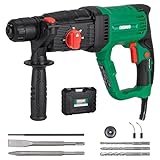
Overview:
This corded 9 Amp SDS-Plus rotary hammer targets DIYers and pros needing reliable concrete drilling. At 7.19 lbs, it prioritizes maneuverability for overhead or tight-space work, featuring a safety clutch and a comprehensive kit with bits, chisels, and a case.
What Makes It Stand Out:
Its standout features include a true 4-mode selector (rotation, hammer, chisel, Vario-lock), variable speed with lock, and tool-less SDS-Plus bit changes. The safety clutch prevents kickback during binding, while the 2.21 ft.lbs. impact energy ensures efficient masonry penetration.
Value for Money:
Priced competitively for corded models, it outperforms cheaper alternatives with its robust motor, included accessories, and durability. Though corded, it avoids battery costs, making it ideal for continuous workshop or site use where outlets are accessible.
Strengths and Weaknesses:
Strengths: Lightweight yet powerful; versatile 4-mode operation; excellent accessory kit; safety clutch reduces injury risk.
Weaknesses: Cord restricts mobility; SDS-Plus compatibility limits bit options; no brushless motor for extended runtime.
Bottom Line:
A reliable, feature-rich corded hammer for frequent concrete work. Best for users prioritizing power and value over cordless freedom; avoid if portability is critical.
7. DongCheng 20V Max Cordless Rotary Hammer Drill, 7/8" SDS-Plus, 4 Application Modes, Brushless, 2.1 Joules, Cordless Demolition Hammer for Concrete, Including 2 * 4.0Ah Battery, 4 Drill Bits

Overview:
This brushless cordless hammer drill offers 2.1 Joules of impact energy and includes two 4.0Ah batteries for extended runtime. Designed for concrete, brick, and masonry, it balances power with ergonomic comfort for prolonged use.
What Makes It Stand Out:
The brushless motor enhances efficiency and longevity, while the 360° anti-vibration handle and cushioned grip significantly reduce user fatigue. Four integrated modes (drill, hammer, chisel, rotary hammer) and SDS-Plus quick-change make it adaptable to diverse tasks without accessory swaps.
Value for Money:
Exceptional value given the dual high-capacity batteries, brushless tech, and included bits. It undercuts premium brands like DeWalt while delivering comparable performance, ideal for contractors needing all-day runtime without tethering.
Strengths and Weaknesses:
Strengths: Dual batteries eliminate downtime; vibration reduction excels; brushless motor saves energy; 4-in-1 functionality.
Weaknesses: Slightly lower impact energy (2.1J) vs. corded rivals; no depth rod in kit; brand recognition lags behind industry leaders.
Bottom Line:
A top-tier cordless option for professionals seeking endurance and comfort. Highly recommended for job sites demanding mobility, though heavy daily users may want higher impact energy.
8. SDS Plus Cordless Rotary Hammer Drill for Dewalt 20v Max Battery, Hammer Drill 20v Brushless for Concrete/Masonry/Wood/Metal, Rotomartillo, 4 Functions, 5 Drills with Gloves (Battery Not Included)

Overview:
A Dewalt 20V Max-compatible brushless hammer drill delivering 2.5 Joules of impact energy. It requires existing Dewalt batteries (not included) and targets users invested in the Dewalt ecosystem for concrete, metal, or masonry work.
What Makes It Stand Out:
Its 2.5J impact energy leads most cordless competitors, and the brushless motor ensures quiet, efficient operation. The 360° auxiliary handle and shock-absorption system enhance control during overhead or precision tasks, while tool-free SDS-Plus changes boost efficiency.
Value for Money:
Good value if you own Dewalt 20V batteries, as brushless performance at this impact level is rare under $200. However, battery exclusion inflates total cost. Lacks premium build quality of Dewalt’s OEM tools but offers solid specs for the price.
Strengths and Weaknesses:
Strengths: High 2.5J impact energy; lightweight compact design; 4 versatile modes; excellent vibration control.
Weaknesses: Batteries sold separately; durability concerns vs. branded tools; no depth rod or case included.
Bottom Line:
A capable budget-friendly alternative for Dewalt battery owners, but prioritize OEM tools if maximum longevity is essential. Avoid if purchasing batteries new.
9. DEWALT 20V MAX SDS Plus 1 Inch Cordless Rotary Hammer with D-Handle, Bare Tool Only (DCH133B)

Overview:
DeWalt’s professional-grade bare-tool cordless hammer packs 2.6 Joules of impact energy in a lightweight frame. Targeting contractors, it excels in structural anchoring and concrete work but requires separate battery and charger investment.
What Makes It Stand Out:
German-engineered mechanism and brushless motor deliver industry-leading 2.6J impact energy for faster drilling. The D-handle and 360° side handle provide superior leverage for heavy-duty tasks, while the rotating dial simplifies mode switching (drill/hammer/chip).
Value for Money:
Justifiable for pros given DeWalt’s reliability and runtime, but expensive as a bare tool. Cheaper than competitors with batteries, yet total cost rises with required DeWalt battery purchases. Best for existing DeWalt 20V Max users.
Strengths and Weaknesses:
Strengths: Highest impact energy here (2.6J); exceptional build quality; D-handle stability; efficient brushless motor.
Weaknesses: Bare tool increases upfront cost; no chisel angle mode; minimal included accessories (depth rod only).
Bottom Line:
A premium, no-compromise tool for serious professionals. Highly recommended for DeWalt loyalists needing top-tier performance, but budget buyers should consider kits.
10. Berserker 20V Cordless 1-1/8" Rotary Hammer Drill SDS-Plus Brushless Motor with Safety Clutch, 4.0Ah Lithium-Ion Battery Powered, 3.0A Fast Charger, 4 Modes Variable Speed Rotomartillo for Concrete

Overview:
This all-inclusive cordless kit features a brushless motor, 2.8J impact energy, and a rapid 1.5-hour charger. At 7.2 lbs, it combines power with portability for concrete, brick, and demolition tasks.
What Makes It Stand Out:
The standout is its 3.0A fast charger (full charge in 90 minutes) and safety clutch for kickback prevention. It includes a rare metal depth gauge, 360° handle, and a comprehensive accessory kit—uncommon at this price point. The 2.8J energy rivals corded models.
Value for Money:
Outstanding value: brushless power, fast charging, and premium accessories (battery, charger, bits, case) undercut competitors by 20–30%. Ideal for cost-conscious pros needing a complete, ready-to-work solution without brand markup.
Strengths and Weaknesses:
Strengths: Best-in-class fast charging; generous accessory bundle; high 2.8J impact; safety clutch; metal depth gauge.
Weaknesses: Brand reliability unproven vs. DeWalt/Makita; battery life may lag under heavy use; limited service network.
Bottom Line:
The smartest budget buy for new buyers. Recommended for DIYers and contractors seeking maximum features per dollar, though brand longevity remains a question.
Why Cordless Rotary Hammers Are Revolutionizing Concrete Work in 2026
Remember the days of wrestling with heavy cords, hunting for generators, or constantly resetting breakers every time you needed to drill into concrete? If you’ve spent any significant time on construction sites, the frustration is etched into your memory as deeply as rebar in fresh pour. The constant tripping hazards, the noise pollution of generators, and the sheer logistical nightmare of managing cords across sprawling job sites weren’t just annoyances—they were productivity killers and genuine safety risks. That era is rapidly fading into history, thanks to the remarkable evolution of cordless rotary hammer technology. By 2026, these tools have transcended their early limitations, transforming from niche alternatives into the undisputed workhorses for concrete professionals demanding power, freedom, and efficiency.
The relentless push for innovation in battery chemistry, motor efficiency, and intelligent tool design has propelled cordless rotary hammers to a point where they genuinely rival, and in many practical scenarios, surpass their corded counterparts for concrete applications. It’s no longer a question of if cordless can handle the job, but which cordless system delivers the optimal blend of raw power, runtime, durability, and user comfort for your specific concrete challenges. Whether you’re installing anchors in a high-rise, retrofitting conduit in a basement, or tackling municipal infrastructure repairs, understanding the critical features that define a top-tier cordless rotary hammer for concrete in 2026 is essential for making a smart, future-proof investment. Let’s dive deep into what truly matters.
Understanding the Core Mechanics: What Makes a Rotary Hammer Shine on Concrete
The Critical Role of Impact Energy (Joules)
When drilling into dense, unforgiving concrete, brute force matters—but it’s not just about raw power. Impact energy, measured in joules (J), is the fundamental metric determining a rotary hammer’s ability to pulverize aggregate and efficiently advance the bit. Too little energy (below 2.0J), and you’re essentially using a powerful drill, risking bit overheating and slow, laborious progress. Too much energy (beyond 3.5J for most standard concrete tasks), and you face excessive vibration, accelerated wear on the tool and bit, and potential damage to surrounding structures. For the vast majority of concrete drilling (anchors, conduit, light rebar), the 2.5J to 3.2J sweet spot offers the ideal balance: sufficient force to chew through 3000-4000 PSI concrete efficiently without unnecessary punishment to the operator or tool. Always match the tool’s energy rating to the concrete density and hole size you routinely encounter.
Rotational Speed (RPM) and Blows Per Minute (BPM): The Dynamic Duo
Impact energy gets the job started, but the synergy between rotational speed (RPM) and blows per minute (BPM) dictates the drilling efficiency. RPM controls how fast the bit rotates, clearing pulverized material from the hole. BPM determines how rapidly the hammer mechanism delivers those powerful impacts. For optimal concrete drilling, a higher BPM (typically 0-4500 BPM) paired with a moderate RPM range (0-1000 RPM) is crucial. This combination ensures rapid pulverization of the concrete face while effectively evacuating debris. Lower RPM prevents the bit from “grabbing” or binding, especially in deeper holes, while a high BPM maintains consistent, aggressive forward motion. Look for tools offering independent or intelligently linked control over these parameters for maximum versatility across different concrete conditions.
The Hammer Mechanism: SDS-Plus vs. SDS-Max – Choosing Your Weapon
The chuck system is non-negotiable for serious concrete work. The industry-standard SDS-Plus (for bits up to 1-1/8" diameter) and SDS-Max (for bits 1-5/8" and larger, tackling heavy demolition or large anchors) systems dominate the professional cordless rotary hammer market in 2026. Their spring-loaded, chuck-free design allows for rapid bit changes and, critically, transmits the full percussive force directly to the bit shank without slippage. This direct energy transfer is vital for efficiency and preventing bit shank damage. Never consider a standard keyed or keyless chuck for concrete hammer drilling; the energy loss and potential for chuck failure under heavy load are unacceptable risks. Ensure the tool you choose features the SDS system appropriate for your typical bit sizes and job demands.
Powering Up: The 2026 Cordless Advantage – Batteries & Motors
Voltage Platforms: The Shift to 36V/40V and 60V/80V Systems
Gone are the days when 18V was considered powerful enough for concrete. The 2026 landscape is clearly segmented. High-performance 36V/40V (nominal) platforms now deliver impressive runtime and sufficient power for frequent drilling up to 1" diameter in standard concrete, making them ideal for electricians, plumbers, and general contractors handling moderate concrete tasks. However, for heavy-duty, all-day concrete drilling, demolition, or large anchor installation, the 60V/80V (nominal) platforms have become the new benchmark. These systems provide the sustained high torque and impact energy needed for the toughest jobs without significant voltage sag, even as the battery discharges. The higher voltage translates directly to more usable power delivery during extended high-load operation—a critical factor when every minute counts on a busy site.
Next-Generation Battery Technology: Beyond Simple Amp-Hours
While Amp-hours (Ah) still indicate capacity, 2026 batteries are defined by far more sophisticated engineering. Lithium-Ion technology has evolved significantly, with high-nickel (NMC) and emerging solid-state variants offering dramatically improved energy density, faster charging (often 30-50% faster than 2023 models), and crucially, much better performance in cold weather – a major historical weakness. More importantly, intelligent battery management systems (BMS) are now standard. These systems actively monitor cell health, temperature, and discharge rates, dynamically adjusting power delivery to prevent overheating, optimize runtime, and significantly extend the overall battery lifespan. Don’t just look at the Ah rating; prioritize tools with batteries featuring advanced thermal management and robust BMS for reliable, long-lasting performance under concrete-drilling duress.
Brushless Motor Dominance: Efficiency, Power, and Longevity
The transition to brushless motors (BLDC) in professional cordless tools is complete for good reason, especially in rotary hammers. Unlike brushed motors, BLDC motors eliminate physical contact points (brushes), resulting in several critical advantages for concrete work:
- Higher Efficiency: Converts more battery power into rotational and percussive force, maximizing runtime per charge.
- Increased Power & Torque: Delivers superior sustained power, especially under heavy load like dense concrete, without bogging down.
- Reduced Maintenance & Longer Life: No brushes to wear out means significantly less downtime and a much longer tool lifespan – essential for tools subjected to constant vibration and shock.
- Smaller Size/Lighter Weight: Allows for more compact tool designs without sacrificing power. Any serious 2026 cordless rotary hammer for concrete will feature a brushless motor; this is non-negotiable for professional durability and performance.
Beyond Raw Power: Ergonomics, Durability, and Smart Features
Taming the Beast: Advanced Vibration Reduction Systems
Concrete hammer drilling generates intense, fatiguing vibration that travels up the tool into the operator’s hands and arms. Prolonged exposure is a serious health hazard (Hand-Arm Vibration Syndrome - HAVS). Modern 2026 tools employ sophisticated multi-stage vibration reduction:
- Internal Counterweights: Actively counterbalance the hammer mechanism’s movement.
- Ergonomic Grip Isolation: Handles made with vibration-dampening materials (like specialized polymers or composite layers) physically separate the user from the main tool body.
- Electronic Dampening: Some high-end models use sensors and microprocessors to momentarily adjust motor power during peak vibration cycles. Prioritize tools with the lowest certified vibration emissions (measured in m/s²) – it’s not just about comfort, it’s a critical safety and productivity feature for all-day use.
Weight Distribution and Balance: The Unsung Hero of Control
A cordless rotary hammer that feels nose-heavy or awkward in the hand is a liability, especially overhead or in tight spaces. Excellent weight distribution is paramount. Look for tools where the motor, battery, and hammer mechanism are engineered to create a near-neutral balance point, typically close to the handle. This makes the tool feel significantly lighter during use, reduces operator fatigue, and provides vastly improved control and precision when applying pressure during drilling. A well-balanced 8.5 lb tool can feel much more manageable than a poorly balanced 7.5 lb tool. Test the balance whenever possible – it dramatically impacts usability.
Built for the Battlefield: Ruggedized Construction Essentials
Concrete sites are harsh environments: dust, moisture, drops, and constant shock. Your 2026 cordless rotary hammer must be engineered for this reality. Key durability features include:
- Metal Gearhousing: Critical for protecting the internal hammer mechanism and gears from impact damage. Avoid plastic housings in high-stress areas.
- Sealed Electronics & Switches: IP54 or higher ingress protection ratings are becoming standard, guarding against concrete dust and light splashes.
- Reinforced Impact Zones: Strategic metal bumpers or reinforced areas where the tool is most likely to be dropped or bumped.
- Dust-Sealed SDS Chuck: Prevents abrasive concrete dust from jamming the bit retention mechanism. Don’t underestimate the importance of robust build quality – it directly translates to tool longevity and reduced downtime.
Intelligent Operation: Modes, Clutches, and Connectivity
Modern cordless rotary hammers offer far more than just “hammer drill” mode. Essential smart features for 2026 include:
- Multiple Operating Modes: Standard drill (no hammer), hammer drill (rotary + percussion), and pure chiseling/hammer-only mode are fundamental. Some offer specialized concrete modes that optimize RPM/BPM based on load.
- Electronic Clutch Systems: Crucial for preventing bit snapping and reducing kickback when the bit binds unexpectedly in rebar or hard aggregate. Automatically disengages rotational force while maintaining percussion.
- Tool-Connectivity (Bluetooth/App): While not essential for everyone, the ability to track runtime, battery health, impact counts (for maintenance scheduling), and even receive firmware updates via a smartphone app is increasingly valuable for fleet management and maximizing tool uptime.
Making the Right Choice: Key Considerations for Your Concrete Workflow
Matching Tool Power to Concrete Density and Hole Size
Not all concrete is created equal. Drilling into 2500 PSI residential slab is vastly different from penetrating 6000 PSI reinforced foundation walls or pre-stressed concrete. Undersizing your tool leads to frustration, slow progress, and burnt-out bits. Oversizing it creates unnecessary vibration, weight, and cost. Analyze your typical job:
- Light Duty (Anchors < 3/8", Conduit): 2.0J - 2.5J, 36V/40V often sufficient.
- Medium Duty (Anchors 1/2" - 3/4", Rebar): 2.8J - 3.2J, 36V/40V robust or 60V/80V preferred.
- Heavy Duty (Anchors 1"+, Demolition, Thick Walls): 3.2J+, 60V/80V essential. Be brutally honest about your most frequent concrete challenges. A tool that excels at small holes might struggle with larger diameters, even in the same concrete.
Runtime Realities: Batteries, Jobsite Logistics, and Duty Cycle
“Will it last the shift?” remains the top concern. Runtime depends on:
- Battery Capacity (Ah) & Voltage: Higher Ah + Higher Voltage = More total energy.
- Concrete Hardness & Hole Diameter: Drilling 1" holes in 5000 PSI concrete drains batteries much faster than 3/8" holes in soft concrete.
- Duty Cycle: Continuous heavy use generates heat; tools need brief cooling pauses to maintain peak performance and battery health. Don’t expect a tool to run non-stop at max load for 8 hours. Factor in your jobsite logistics: Do you have reliable charging? Can you carry spare batteries? For critical deadlines or remote sites, investing in extra high-capacity (6.0Ah+) batteries for your chosen platform is often more cost-effective than buying a second tool. Understand the real-world runtime for your typical task, not just the manufacturer’s best-case scenario.
The Total Cost of Ownership: Beyond the Initial Price Tag
The sticker price is just the beginning. True value lies in Total Cost of Ownership (TCO):
- Battery & Charger Ecosystem: Are batteries/chargers compatible with other tools you own (drills, saws)? Sharing platforms saves significant long-term cost.
- Durability & Repairability: A slightly more expensive tool that lasts 5+ years outperforms a cheap one replaced annually. Check warranty terms and service network availability.
- Bit & Accessory Cost: SDS bits are standard, but verify compatibility and cost for your chosen system. Specialized chisels add up.
- Productivity Gains: A faster, more reliable tool that reduces fatigue completes jobs quicker, directly impacting your bottom line. Factor in the cost of downtime from tool failure. Think long-term. The cheapest tool often becomes the most expensive over time.
Safety First: Non-Negotiable Practices with Cordless Concrete Tools
Concrete-Specific Hazards: Dust, Rebar, and Kickback
Cordless freedom doesn’t eliminate the inherent dangers of concrete work:
- Silica Dust: Concrete drilling creates hazardous crystalline silica dust. Always use a vacuum shroud connected to a HEPA-filtered dust extractor. Respirators (P100) are mandatory if extraction isn’t perfect. This is a severe health risk, not optional.
- Rebar Strikes: Hitting rebar can cause violent bit binding and kickback. Use electronic clutch modes, maintain firm grip with both hands, and position your body safely (never directly in line with the bit). Be aware of likely rebar locations.
- Kickback: Sudden binding can jerk the tool violently. Proper stance, two-handed grip, and electronic safety features are critical defenses. Never force the tool.
Leveraging Cordless Safety Advantages
While the hazards remain, cordless tools offer unique safety benefits:
- Eliminating Trip Hazards: No cords snaking across uneven ground or through doorways drastically reduces fall risks.
- Reduced Electrocution Risk: No exposed cords near water or damaged insulation (though battery safety is paramount – avoid puncturing, extreme heat/cold).
- Quieter Operation: While still loud, cordless tools (especially without generators) reduce overall site noise pollution, improving communication and situational awareness. Always wear hearing protection regardless. Prioritize tools with robust safety features (clutches, vibration reduction) and pair them with strict adherence to PPE and safe work practices. Safety is your most important tool.
Frequently Asked Questions
Frequently Asked Questions
Can a cordless rotary hammer truly match the power of a corded model for heavy concrete drilling in 2026?
Yes, absolutely. High-end 60V/80V cordless models now deliver impact energy (3.0J+) and sustained power output that rivals most professional corded units for standard concrete drilling and chiseling tasks. While corded still holds a slight edge for continuous 24/7 operation in extreme industrial settings, cordless performance for typical job site demands is more than sufficient and often preferred due to mobility.
How many holes can I realistically drill in 3000 PSI concrete on a single 6.0Ah battery?
This varies significantly based on hole diameter, bit sharpness, and technique. As a rough 2026 benchmark: Expect 40-60 holes with a 1/2" bit, 25-40 holes with a 5/8" bit, and 15-25 holes with a 3/4" bit in standard 3000 PSI concrete. Harder concrete or larger holes will reduce this count. Always carry at least one spare high-capacity battery for full-day productivity.
Is vibration really less on modern cordless rotary hammers compared to older corded ones?
Significantly less, yes. Advanced multi-stage vibration reduction systems (counterweights, isolated handles, electronic dampening) in 2026’s top cordless models often result in lower certified vibration emissions (m/s²) than many older corded hammers. This is a major ergonomic and safety advancement, reducing fatigue and HAVS risk.
Do I need SDS-Max for most concrete anchor work, or is SDS-Plus sufficient?
SDS-Plus is perfectly adequate and standard for the vast majority of concrete anchor drilling (up to 1-1/8" bits). SDS-Max is primarily for heavy demolition, large-hole drilling (1-5/8"+), or extremely dense/reinforced concrete where maximum impact energy is needed. For typical 1/4" to 3/4" anchor holes, SDS-Plus is the right choice, offering wider bit availability and lighter tool weight.
How does cold weather affect cordless rotary hammer performance on concrete sites?
While modern 2026 batteries (especially high-nickel chemistries with advanced BMS) handle cold much better than older models, expect some reduction in usable runtime (15-25% less) below 40°F (4°C). Keep spare batteries warm in an inside pocket until needed, and allow the tool/battery to acclimate briefly before heavy use. Avoid charging below freezing.
Can I use a cordless rotary hammer for light demolition on concrete?
Yes, but choose the right mode and tool. Use the hammer-only (chiseling) mode, not rotary hammer mode. A tool with 2.8J+ impact energy is suitable for breaking small chunks, chipping edges, or removing tile/setts. For serious concrete demolition (slabs, walls), a dedicated higher-joule demolition hammer (often SDS-Max) is more efficient, but a capable rotary hammer is versatile for smaller tasks.
Why is an electronic clutch so important for concrete drilling?
When the bit suddenly binds on rebar or hard aggregate, the rotational force can cause violent kickback or snap the bit. An electronic clutch instantly disengages the rotational drive while maintaining percussion, drastically reducing kickback risk and preventing dangerous bit breakage – a critical safety feature for unpredictable concrete.
Are the higher voltage (60V/80V) platforms worth the extra cost and weight?
For frequent, heavy concrete work (daily drilling over 1/2", thick walls, large anchors), absolutely. The superior sustained power, reduced voltage sag under load, and longer runtime per battery justify the investment and slight weight increase. For occasional light-duty concrete work, a robust 36V/40V platform offers excellent value and maneuverability.
How do I maximize the lifespan of my cordless rotary hammer when used daily on concrete?
Key practices: Always use sharp, high-quality SDS bits; apply firm, consistent pressure without forcing; allow brief cooling pauses during heavy use; keep the SDS chuck clean and lubricated (as per manual); store batteries at ~40-60% charge in a cool, dry place; use the electronic clutch; and promptly address any unusual noises or performance drops with professional service.
Is the added cost of tool connectivity (Bluetooth/app) worthwhile for concrete work?
For individual users, it’s often a nice-to-have for tracking battery health and usage. For contractors managing fleets, it becomes highly valuable for monitoring tool utilization, scheduling preventative maintenance based on actual impact counts, verifying battery performance, and optimizing tool allocation – potentially saving significant downtime and replacement costs over time.
See Also
- 10 Expert-Recommended Cordless Rotary Hammers for Concrete Work in 2026
- 10 Must-Have Hammers for Concrete Nailing in 2026
- 10 Game-Changing Drills for Concrete Anchoring in 2026
- 10 Game-Changing Mini Saws for Tile Installation in 2026
- We Tested 50 Wall Scanner Tools - Here Are the 10 Best for Tile Installation